
Why Commercial Gas Pipe Installation Standards Matter for Your Business
Commercial gas pipe installation is one of the most safety-critical projects a business can undertake — and getting it wrong can have devastating consequences.
Here’s a quick overview of what you need to know:
| Topic | Key Point |
|---|---|
| Core standards | NFPA 54, IFGC, BS6891, DSEAR |
| Approved materials | Black iron steel, CSST, copper, polyethylene |
| Pressure testing | Must withstand 1.5x maximum operating pressure |
| Who installs it | Licensed Master Gasfitters only |
| Permits required | Yes — always, before work begins |
| Inspection frequency | Annually, or per local regulations |
Commercial gas systems power everything from restaurant kitchen equipment to industrial heating. They carry serious risks when installed improperly. The 2010 San Bruno pipeline explosion — caused by a faulty gas line installation — killed 8 people and destroyed multiple homes. That’s not a worst-case hypothetical. It’s a real outcome of skipping standards.
This guide breaks down exactly what commercial gas piping involves, which standards apply, and what to expect from a professional installation.
I’m Reese Mitchell, owner of Great Basin Plumbing, and I’ve worked on commercial gas pipe installation projects across the region — from restaurant kitchen hookups to multi-zone commercial heating systems. I’ll walk you through everything you need to know to keep your business safe and compliant.
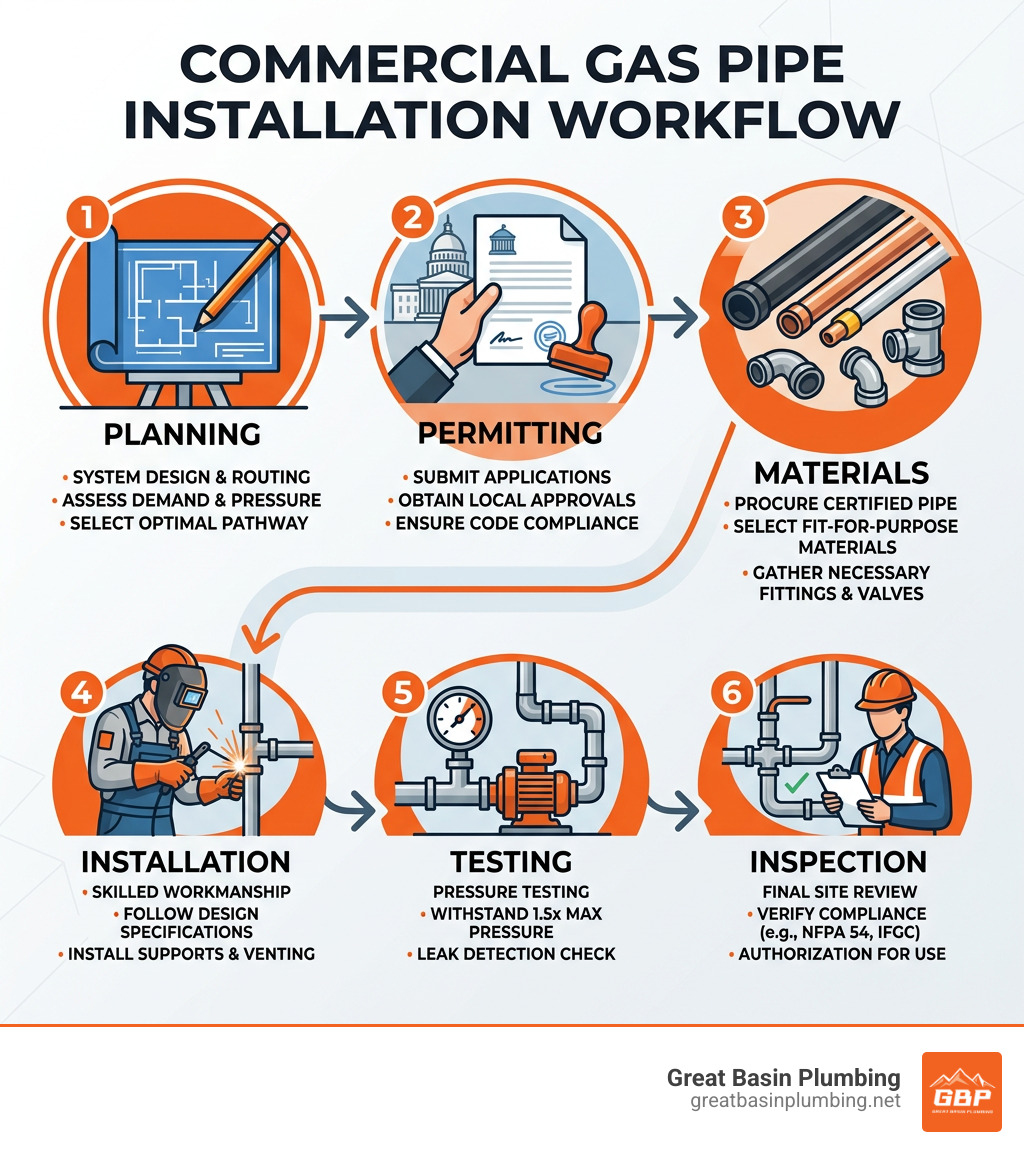
Commercial gas pipe installation basics:
Essential Standards for Commercial Gas Pipe Installation
When we talk about standards in the gas world, we aren’t just talking about “suggestions.” We’re talking about the law. In Utah, from Salt Lake City down to Orem and up to Brigham City, we follow a strict set of rules to ensure that every commercial gas pipe installation is rock solid.
The “big two” in the United States are the NFPA 54 (National Fuel Gas Code) and the IFGC (International Fuel Gas Code). These documents are the bibles of the industry. They dictate everything from how deep a pipe needs to be buried to exactly what kind of thread sealant we can use. If a contractor tells you they “know a guy” who can do it cheaper without following these, run the other direction. Fast.
For those looking at international safety benchmarks or specific high-tech systems, BS6891 safety standards provide rigorous specifications for low-pressure pipework. Additionally, the DSEAR (Dangerous Substances and Explosive Atmospheres Regulations) framework is vital for industrial settings. It requires a thorough risk assessment to ensure that any potential gas release is managed.
One of the most technical parts of these standards is achieving a Zone 2 Negligible Extent (Zone 2 NE) classification. This essentially means the system is designed so well that even if a small leak occurs, the background gas concentration stays below 10% of the Lower Explosive Limit (LEL). To get there, we have to ensure leak rates stay under 1 gram per second. It’s high-level engineering, but it’s what keeps your employees safe.
Locally, we also have to navigate specific Utah gas line plumbing services requirements. Every city, whether it’s Sandy or Draper, has its own nuances regarding permits and inspections. We handle all of that coordination so you don’t have to spend your afternoon arguing with a city inspector.
Recommended Materials and the Role of CSST
Choosing the right material for your commercial gas pipe installation isn’t just about price; it’s about the environment where the pipe will live. If you put the wrong metal in a corrosive environment, you’re just counting down the days until a leak.
The Heavy Hitters: Steel and Copper
Black iron steel is the traditional champion of commercial gas. It’s incredibly strong and handles high pressure like a pro. However, it’s heavy and prone to corrosion if not treated correctly. Copper tubing is also common, especially for indoor runs where flexibility and heat conductivity are needed.
The Modern Alternative: CSST
Then there’s CSST (Corrugated Stainless Steel Tubing), like Flexigas. This stuff has changed the game. Traditional steel or copper pipes require a joint every 3 meters. Every joint is a potential “hotspot” for a leak. CSST comes in long, continuous coils.
The Leak Point Math:
- Traditional Pipe: Requires a joint every 3 meters. In a 30-meter run, that’s 10 potential leak points.
- CSST: One continuous length. Only 2 potential leak points (one at each end).
| Feature | Black Iron Steel | CSST (Flexible) | Copper |
|---|---|---|---|
| Durability | Very High | High | Medium |
| Ease of Install | Difficult (Heavy) | Very Easy | Easy |
| Corrosion Resistance | Low (Needs coating) | Excellent | High |
| Joint Frequency | Every 3 Meters | Ends Only | Every 3-6 Meters |
| Best Use | Main Supply Lines | Kitchen Retrofits | Small Appliance Runs |
One critical note on CSST: it must be properly bonded and grounded. Because it’s a thinner material than heavy steel, an electrical surge (like a lightning strike) could potentially puncture it if the system isn’t grounded. We always ensure safe gas connector use by following manufacturer-specific bonding requirements.
The Professional Commercial Gas Pipe Installation Process
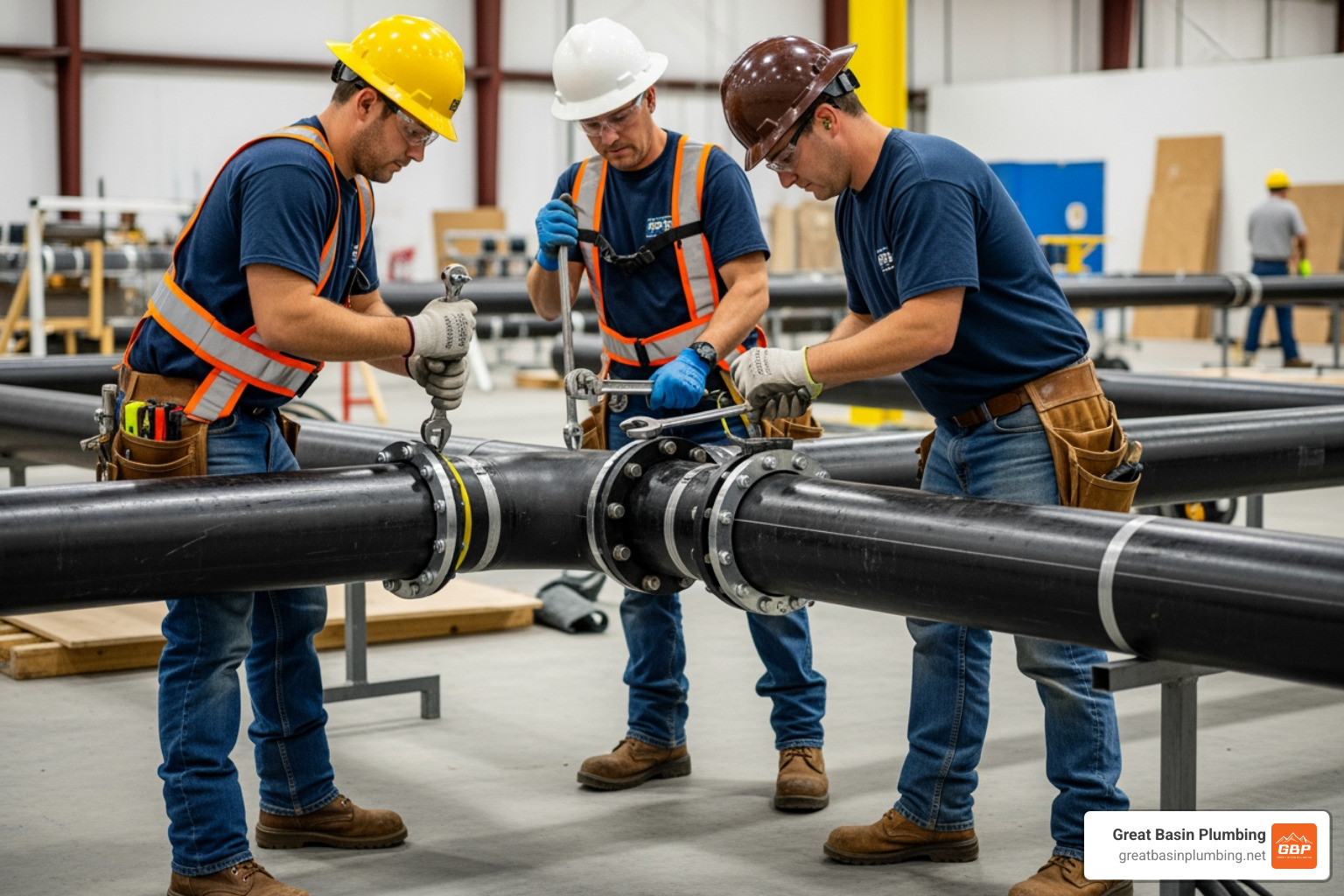
A professional commercial gas pipe installation is a choreographed dance between planning, permitting, and execution. It’s not a weekend DIY project.
Planning and Sizing for Commercial Gas Pipe Installation
Before we even pull a wrench out of the truck, we have to do the math. We calculate the BTU (British Thermal Unit) demand for every single appliance in your building. A commercial range might need 250,000 BTUs, while a massive boiler could need millions.
If we undersize the pipes, your appliances won’t get enough fuel, leading to poor performance and “nuisance” shutdowns. If we oversize them, you’re wasting money on materials. We also look at future scalability. If you’re a restaurant in South Jordan and you think you might add another pizza oven next year, we’ll size the manifold now so you don’t have to pay for a total professional piping and repiping job later.
Execution and Connection in Commercial Gas Pipe Installation
Once the plan is set and the permits are in hand, the physical work begins. We start by installing the main shut-off valves and the manifold assembly.
Key steps we take during execution include:
- Threaded Joints: We use high-quality pipe dope or yellow Teflon tape specifically rated for gas.
- Support Hangers: Gas pipes can’t just hang out. They need rigid support every few feet to prevent sagging and stress on the joints.
- Sediment Traps: Also known as “drip legs,” these are vertical pipe extensions that catch moisture and debris before they can clog up your expensive appliances.
- Appliance Connection: We ensure we are connecting gas lines properly using the correct flexible or rigid connectors based on the appliance’s mobility.
Safety Precautions and Rigorous Testing Procedures
Testing is the most important part of our job. We don’t just turn the gas on and “hope for the best.” We use a process called air pressure testing.
Before any gas enters the system, we pump it full of air (or an inert gas like nitrogen) to 1.5 times the maximum operating pressure. If that needle on the gauge moves even a fraction of an inch over 24 hours, we have a leak, and we don’t stop until we find it.
Our Leak Detection Toolkit:
- Electronic Sniffers: High-sensitivity handheld devices that can detect methane in parts per million.
- Soap Bubble Solution: The old-school, foolproof method. If it bubbles, it’s leaking.
- Ventilation Checks: We verify that your kitchen’s hood system and makeup air units are functioning correctly. Gas needs oxygen to burn, and without proper ventilation, you risk carbon monoxide buildup or oxygen displacement.
Natural gas is naturally odorless. Utility companies add that “rotten egg” smell (mercaptan) so you can detect it, but in a loud, busy commercial kitchen in Salt Lake City, you might not notice it. That’s why we also recommend installing high-quality gas detection systems that can automatically trigger an emergency shut-off.
Planning, Permits, and Long-Term Maintenance
A commercial gas pipe installation is an investment in your business’s infrastructure. To protect that investment, you need to think beyond the first day of operation.
Permits and Utility Coordination
In places like Magna or Park City, the utility company (like Dominion Energy) needs to be involved if you’re significantly increasing your gas load. We often assist businesses with utility meter upgrades. If you add a massive new HVAC unit but keep your old residential-sized meter, the system will starve for fuel.
The Importance of Maintenance
Gas systems are not “set it and forget it.” Over time, valves can seize, hangers can loosen, and vibrations from heavy machinery can stress joints. We recommend following a preventative maintenance guide that includes:
- Annual Inspections: A full walkthrough to check for corrosion and wear.
- Component Testing: Making sure every emergency shut-off valve actually works when you need it to.
- Leak Sweeps: Using electronic detectors to check all connections.
Utilizing professional plumbing inspection services ensures that you stay compliant with fire codes and insurance requirements, which can save you a fortune in premiums and prevent costly business downtime.
Frequently Asked Questions about Commercial Gas Systems
How often should commercial gas lines be inspected?
In a commercial environment—especially a high-use kitchen—we recommend annual inspections. If you operate a high-volume facility in Ogden or Orem, the constant heat and moisture can accelerate wear on fittings. Regular checks aren’t just for safety; they are often required for your business insurance and local fire department certifications.
What are the signs of a commercial gas leak?
The most obvious sign is the rotten egg odor. However, you should also listen for hissing sounds near appliances or wall cavities. If you have outdoor lines, look for dead vegetation or bubbling in puddles. An unexplained, sudden spike in your gas bill is another red flag. If you suspect a leak, evacuate the building immediately and call us—we offer 24/7 emergency response for these exact situations.
Why is professional installation required for commercial kitchens?
Commercial kitchens are complex. You aren’t just hooking up one stove; you’re balancing the load of fryers, ovens, broilers, and water heaters. A licensed Master Gasfitter understands how to calculate pressure drops across long runs and ensure every appliance gets the exact flow it needs. Furthermore, DIY or uncertified work can void your equipment warranties and lead to massive liability if an accident occurs.
Conclusion
At the end of the day, a commercial gas pipe installation is about peace of mind. You want to know that when you turn on your equipment in the morning, it’s going to work efficiently and safely.
Whether you’re building a new restaurant in Sandy, UT, or upgrading an industrial facility in Heber, we’re here to help. At Great Basin Plumbing, we bring years of local experience, a deep understanding of Utah’s specific codes, and a commitment to honest, upfront pricing. We don’t cut corners because we know that in this business, corners are where the risks live.
If you need expert Utah gas line plumbing, don’t leave it to chance. Give us a call, and let’s make sure your business is powered safely for the long haul.