
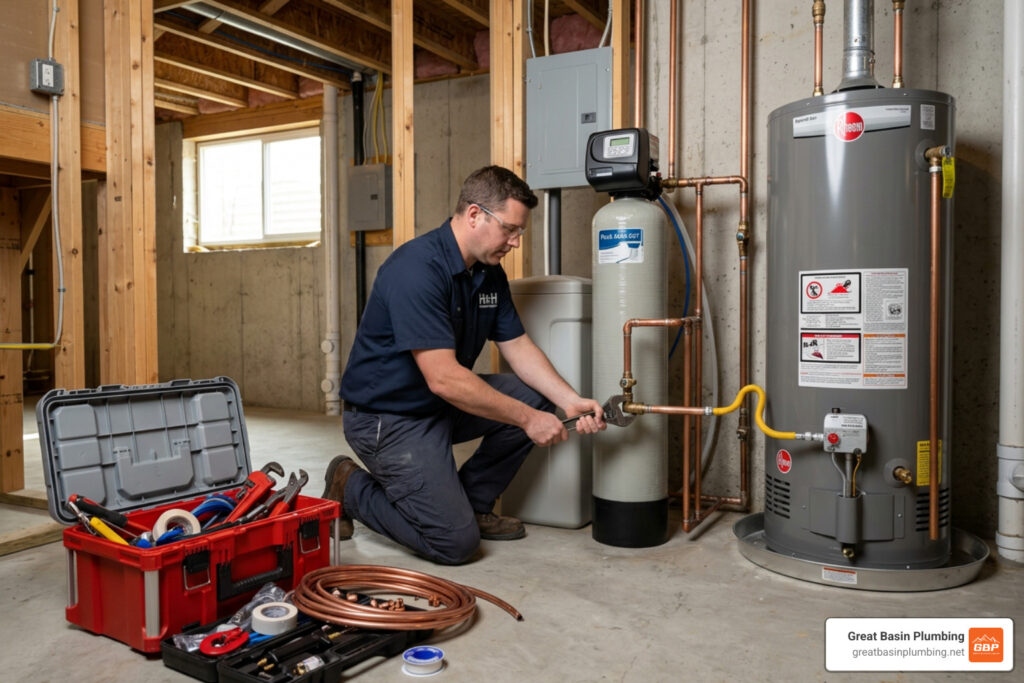
What Does Water Softener Installation Actually Cost?
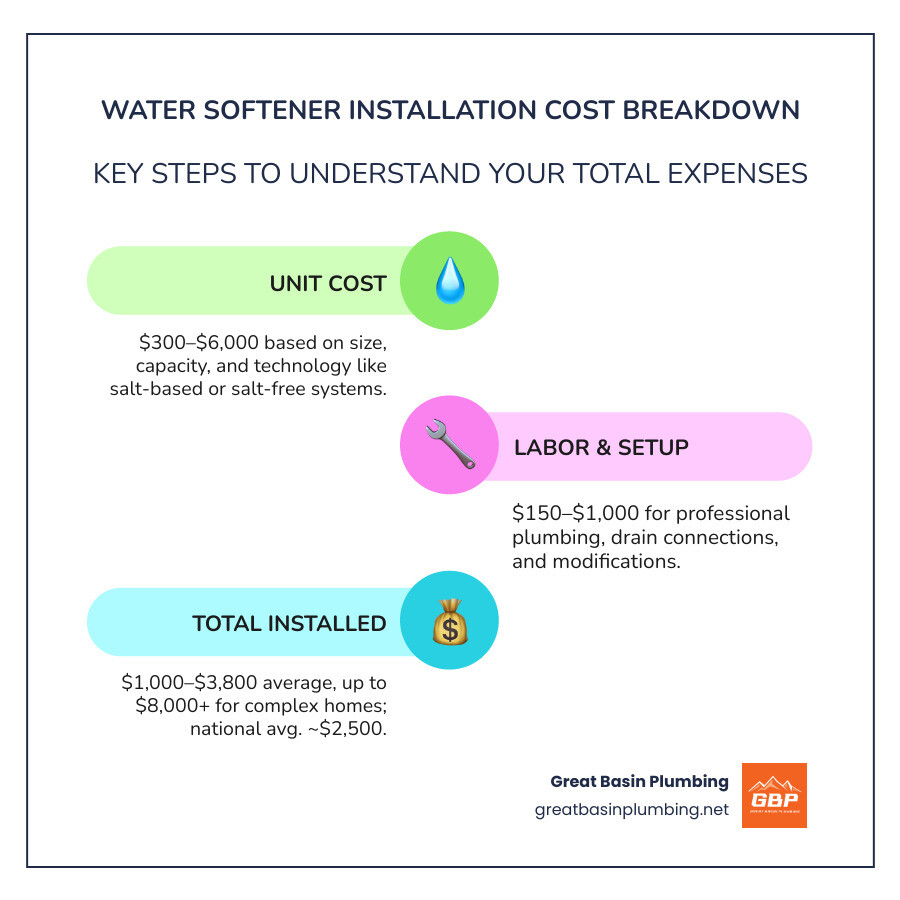
Water softener installation cost typically falls between $1,000 and $3,800 for most homeowners, including the unit and professional labor. Here’s a quick snapshot:
| Cost Category | Typical Range |
|---|---|
| Water softener unit only | $300 – $6,000 |
| Professional installation labor | $150 – $1,000 |
| Total installed cost (most homeowners) | $1,000 – $3,800 |
| National average (all-in) | ~$2,500 |
| Budget minimum | ~$800 |
| High-end / complex systems | Up to $8,000+ |
Prices vary based on system type, your home’s plumbing setup, local water hardness, and household size. We’ll break all of that down clearly below.
Hard water is more common than most people realize. Nearly 85% of American households deal with it. In areas like Salt Lake City and Sandy, UT, mineral-heavy water quietly damages pipes, shortens appliance lifespans, and drives up energy bills — often without homeowners connecting the dots.
A water softener solves that. But the cost to install one can range dramatically — from a few hundred dollars for a basic DIY setup to several thousand for a professionally installed, high-capacity system. Knowing what drives that range helps you make a smarter decision for your home and budget.
I’m Reese Mitchell, owner of Great Basin Plumbing, and I’ve helped homeowners across the region navigate water softener installation cost decisions — from choosing the right system size to avoiding expensive plumbing surprises during installation. Let’s walk through exactly what you can expect to pay, and why.
Breaking Down the Average Water Softener Installation Cost
When we talk about the water softener installation cost, we are looking at two primary buckets: the hardware (the machine itself) and the professional expertise required to integrate it into your home’s veins.
The unit price alone can vary wildly. A compact, budget-friendly unit might sit at the $500 mark, while complex, multi-stage systems can reach $6,000. However, the “sweet spot” for most residential properties in Utah is between $1,500 and $3,000 for a complete, high-quality setup.
Estimating Labor and Setup Fees
Labor is where many homeowners see the most variation. If your home is already “pre-plumbed” for a softener—meaning a builder already ran the necessary loops and drains to a specific spot—installation labor might only cost between $150 and $300.
However, if we need to perform significant Utah Plumbing Services to create a connection point, the price increases. This includes:
- Main Line Tapping: Cutting into your main water line to divert flow through the softener.
- Drainage Lines: Installing a dedicated line to carry away the brine discharge during regeneration cycles.
- Brine Tank Placement: Ensuring the salt tank is accessible for easy refills while remaining near the mineral tank.
On average, professional labor for a standard installation ranges from $500 to $1,000, depending on the complexity of your home’s layout.
Permit and Inspection Costs
Don’t forget the paperwork! Most municipalities in the Salt Lake Valley and surrounding counties require a plumbing permit for new water treatment installations. This ensures the work meets local building codes and prevents issues like cross-contamination with the city’s water supply. Permits typically add $50 to $150 to the total project.
Furthermore, we always recommend looking for equipment with NSF/ANSI certifications. Specifically, NSF/ANSI 44 is the gold standard for ion-exchange water softeners, proving the system effectively removes hardness and is built with safe, durable materials.
Factors That Influence Your Total Investment
Not every home is created equal, and neither is the water flowing into it. Several variables will dictate whether your water softener installation cost leans toward the lower or higher end of the spectrum.
How Home Size and Hardness Affect Water Softener Installation Cost
The “size” of a water softener isn’t about its physical dimensions, but its grain capacity. This refers to how many grains of “hardness” (calcium and magnesium) the system can remove before it needs to regenerate.
To find the right size, we look at:
- Household Occupancy: The EPA estimates the average American family uses over 300 gallons of water per day. More people equals more water, which requires a higher-capacity tank.
- Water Hardness Level: Measured in Grains Per Gallon (GPG). If your water is “Very Hard” (over 10.5 GPG), the resin beads inside the tank will saturate faster, necessitating a larger system or more frequent regeneration.
For example, a 4-person household with 10 GPG hardness typically needs a 32,000-grain unit. If that same family lived in an area with 20 GPG, they might need a 48,000 or 64,000-grain system to avoid constant salt usage and wear on the valves.
Location and Regional Price Variations
Geography plays a massive role. According to the U.S. Geological Survey’s water hardness map, much of the Mountain West—including Utah—is categorized as having “Hard” to “Very Hard” water.
In cities like Sandy, Draper, and South Jordan, the high mineral content means systems work harder. In more remote areas like Park City or Heber, travel fees for technicians might slightly increase the labor portion of your bill. When choosing Utah Water Treatment Systems, work with a local team that understands the specific mineral profile of your neighborhood’s water.
Comparing Costs by System Type and Technology
The technology you choose is the biggest “lever” you can pull to change your total price.
Salt-Based vs. Salt-Free Water Softener Installation Cost
This is the most common debate.
- Salt-Based (Ion Exchange): These are the industry standard. They use resin beads and salt to actually remove calcium and magnesium. They cost between $1,200 and $3,800 installed. They are the most effective for truly soft water.
- Salt-Free (Water Conditioners): These don’t remove minerals; they use “Template Assisted Crystallization” (TAC) to prevent minerals from sticking to pipes. These often cost $1,500 to $4,500. While they require less maintenance (no salt bags!), they don’t provide that “slippery” soft water feel.
For a deeper dive into these differences, check out our guide on Pure Simple: Understanding Water Treatment Systems Across Utah.
Advanced Filtration and Reverse Osmosis Pricing
Some homeowners want more than just soft water; they want purified water.
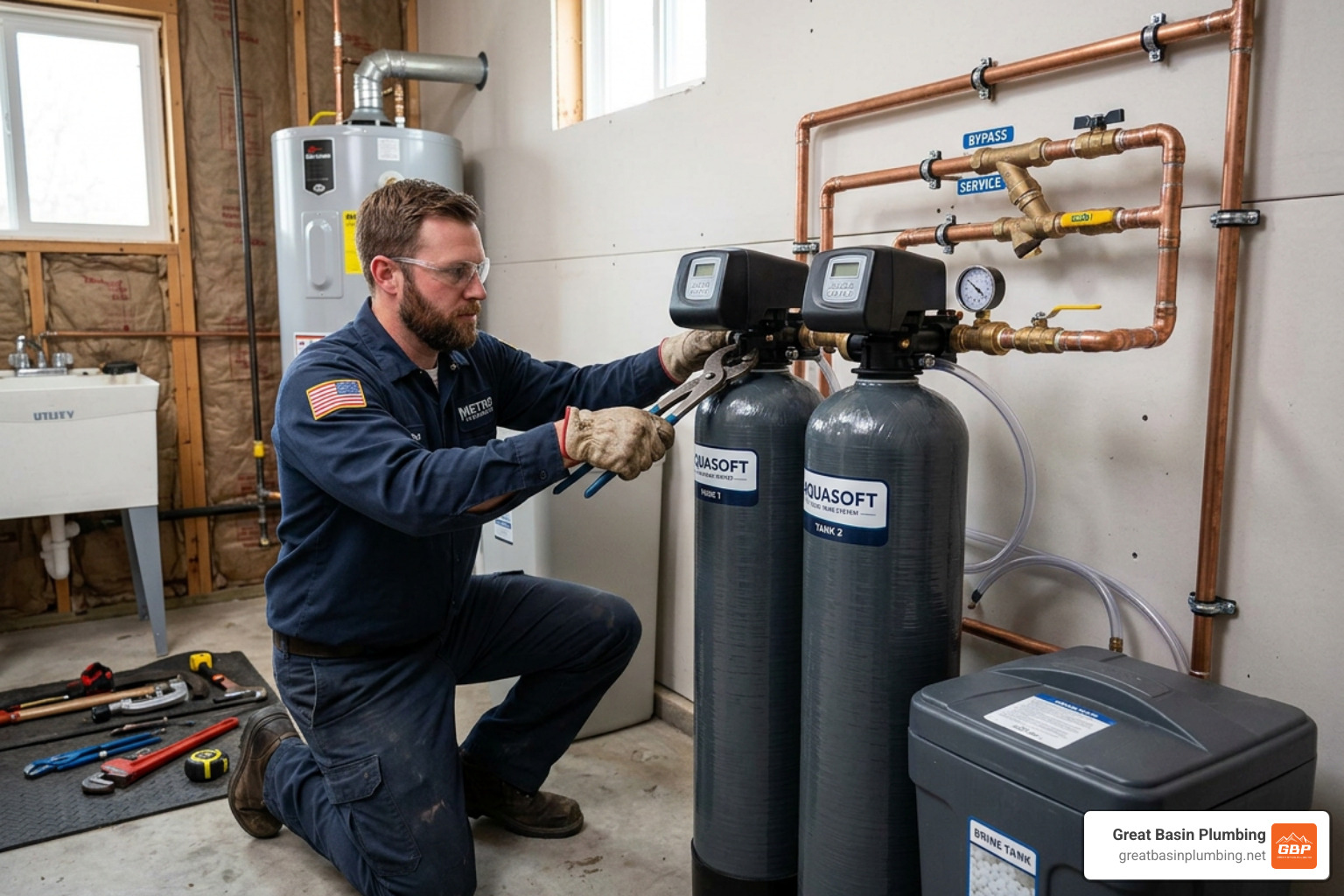
- Dual-Tank Systems: These cost $1,700 to $5,000 and provide soft water 24/7 by switching tanks when one needs to regenerate.
- Whole-Home Reverse Osmosis (RO): This is the “luxury” option, removing nearly all contaminants. These can cost anywhere from $4,000 to $11,000.
- Magnetic/Electronic Descalers: These are the cheapest options ($200 – $600), but there is significant scientific research on magnetic system effectiveness that suggests they may not be effective for all homes, as they don’t actually remove minerals.
Long-Term Operating and Maintenance Expenses
Your water softener installation cost is an upfront investment, but you should also budget for the “fuel” that keeps it running.
Ongoing Consumables and Salt Costs
A standard ion-exchange system requires salt. Most families go through one 40-lb bag every month or two.
- Salt Bags: $5 to $10 per bag.
- Potassium Chloride: A salt alternative for those on low-sodium diets, though it costs significantly more at $30 to $70 per bag.
- Annual Maintenance: We recommend a professional inspection every 1-2 years ($100 – $300) to clean the brine tank and ensure the valve is cycling correctly.
System Lifespan and Repair Budgeting
A well-maintained water softener can last 15 to 20 years. However, the resin beads eventually wear out (usually after 10-12 years) and may need replacement. Budgeting about $150 per year for potential repairs or component wear will ensure you aren’t caught off guard by a valve failure or a “salt bridge” issue.
Frequently Asked Questions about Water Softener Costs
Is DIY installation cheaper than hiring a professional?
Technically, yes—you can save $500 to $1,000 in labor. However, we’ve seen many DIY projects go south. Improperly soldered joints, backward connections (sending hard water into the “out” port), or lack of a proper bypass valve can lead to expensive water damage. Plus, most manufacturer warranties are only valid if a licensed professional performs the installation.
How do I calculate the right water softener capacity for my home?
Use this simple formula: (Number of People) x (90 Gallons/Day) x (Grains of Hardness) = Daily Grains to be Removed. If you have 4 people and 10 GPG hardness, you need to remove 3,600 grains per day. A 32,000-grain tank would then regenerate roughly every 7-9 days, which is ideal for efficiency.
Are water softeners worth the investment for city water?
Absolutely. Even “treated” city water in Utah is often very hard. Softening your water can:
- Save 25-50% on soap and detergent costs.
- Extend the life of your water heater by up to 50%.
- Prevent “scale” buildup in expensive appliances like dishwashers and coffee makers. For most Utah families, the system pays for itself in savings within 3 to 5 years.
Conclusion
Investing in a water softener is one of the most impactful upgrades you can make for your home’s longevity and your family’s comfort. While the water softener installation cost might seem like a hurdle, the long-term protection it offers your plumbing and appliances far outweighs the initial price tag.
At Great Basin Plumbing, we pride ourselves on being a local, family-owned business that treats your home like our own. Whether you’re in Sandy, Brigham City, Ogden, or Park City, we offer honest, upfront pricing and 24/7 emergency support. We don’t believe in “one-size-fits-all” solutions—we’ll test your water and help you choose the system that fits your budget and your GPG levels perfectly.
Ready to say goodbye to dry skin and crusty faucets? Schedule your Utah water treatment system installation with us today, and let’s get your home the high-quality water it deserves.