
Why Drain Leak Detection Could Save Your Home (and Your Wallet)
Drain leak detection is the process of locating hidden leaks in your home’s pipes, drains, and fixtures before they cause serious damage. Here’s a quick overview of what you need to know:
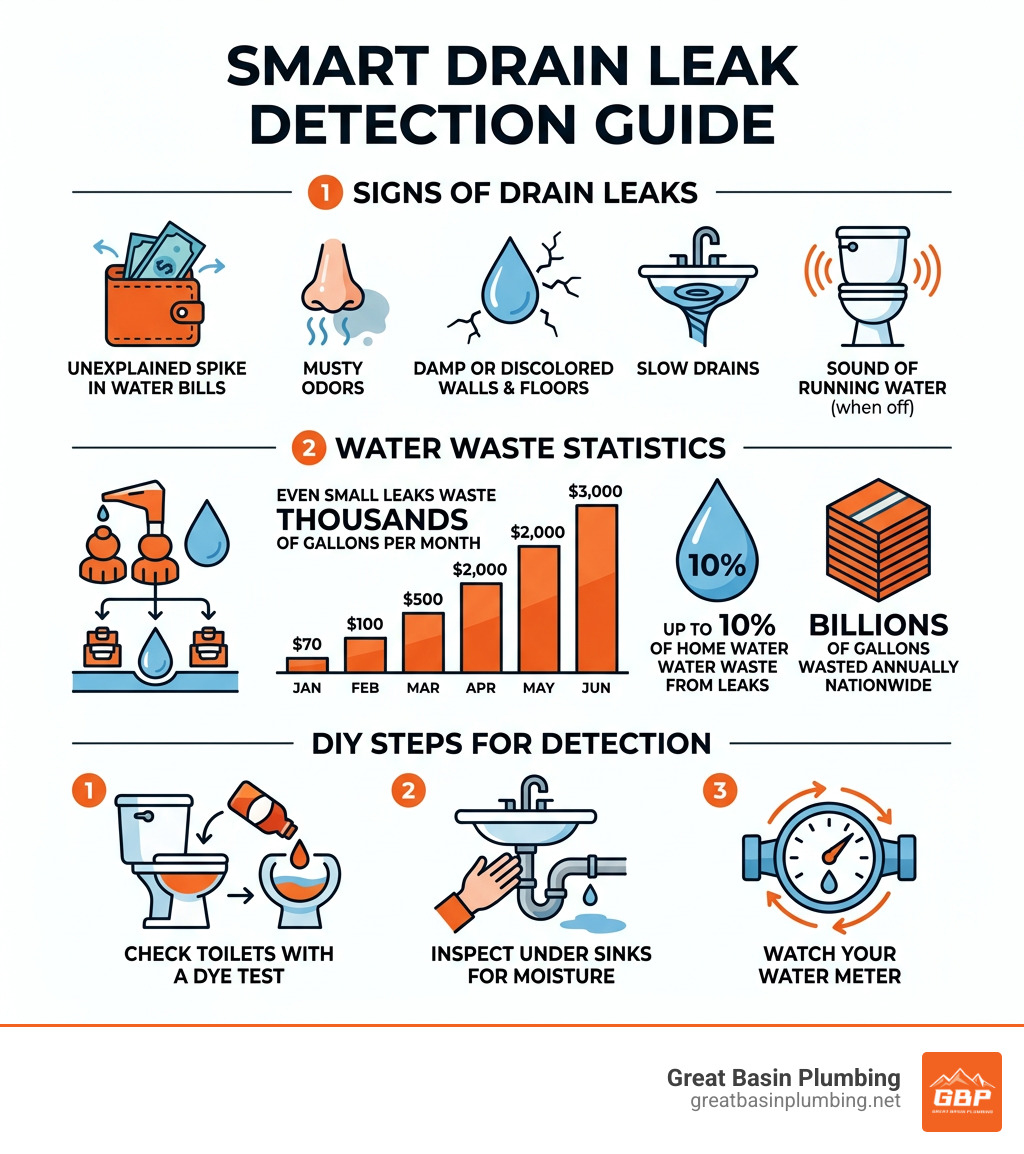
- Common signs of a drain leak: unexplained spike in water bills, musty odors, damp or discolored walls and floors, slow drains, or the sound of running water when everything is off
- DIY first steps: check toilets with a dye test, inspect under sinks for moisture, and watch your water meter for movement when no water is in use
- When to call a pro: if you can’t find the source, suspect a slab leak, or see signs of mold or structural damage
- Professional methods: acoustic sensors, infrared imaging, and sewer camera inspection can locate leaks without tearing up your home
Even the smallest leak can waste thousands of gallons of water every month — and most homeowners don’t notice until the damage is already done. That means a higher water bill, potential mold growth, and in serious cases, structural damage that costs far more to fix than the original leak would have.
The frustrating part? Many drain leaks are completely hidden. They live inside walls, under concrete slabs, or buried in your yard — silently doing damage while your plumbing looks perfectly normal on the surface.
I’m Reese Mitchell, owner of Great Basin Plumbing, and I’ve spent years helping Sandy, UT homeowners track down and fix exactly these kinds of hidden leaks through hands-on drain leak detection work. In this guide, I’ll walk you through everything you need to know — from spotting the early warning signs to understanding when it’s time to bring in professional equipment.
Glossary for drain leak detection:
Common Signs of Hidden Drain and Water Leaks

When we think of a plumbing problem, we often imagine a geyser erupting from under the kitchen sink. In reality, most issues are much sneakier. Even the smallest leak in your water system can cause the loss of thousands of gallons of water each month. That loss isn’t just an environmental concern; it’s a direct hit to your bank account.
In our experience serving areas from Ogden down to Orem, the signs of a leak often manifest in ways that homeowners initially dismiss as “just part of an old house.” However, staying vigilant can prevent a catastrophe. Here are the red flags we tell our customers to look for:
- Musty Odors: If a room smells like a damp basement even after you’ve cleaned it, there’s likely moisture trapped behind a wall or under the floorboards. This is a classic sign that drain leak detection is needed.
- Peeling or Bubbling Paint: When water leaks inside a wall, the drywall absorbs it like a sponge. This causes the paint or wallpaper to lose its adhesion, leading to unsightly bubbling or peeling.
- Unexplained Spikes in Utility Bills: If your water usage habits haven’t changed but your bill has skyrocketed, you have a “silent thief” in your pipes.
- Lush Patches in the Lawn: Is one part of your yard suspiciously greener and faster-growing than the rest? While it might look nice, it often indicates a leaking sewer or service line that is essentially “fertilizing” the grass with wastewater.
- Rodent and Insect Activity: Pests are drawn to moisture. A sudden influx of cockroaches or even rats can be a secondary sign of a cracked sewer pipe providing them with a water source and an entry point.
- Slow Drains and Sewage Backup: If multiple drains in your home are sluggish, the issue is likely deeper in your main line.
For more detailed insights, you can check out More info about Utah plumbing leak detection to see how these signs specifically impact homes in our unique Utah climate.
Identifying Indoor Fixture Leaks
Before calling in the heavy machinery, there are several “detective” steps you can take yourself. Indoor fixtures like toilets and faucets are the most common culprits for water waste.
The Leaky Toilet Toilets are the heavy hitters of indoor water use. According to the EPA’s Water Sense website, toilets account for nearly 30 percent of an average home’s indoor water consumption. Older, inefficient toilets can use as much as 6 gallons per flush!
To see if your toilet is leaking, try the Dye Test:
- Remove the tank lid.
- Drop a few drops of food coloring (or a dye tablet) into the tank.
- Wait 15–20 minutes without flushing.
- If the color seeps into the bowl, your flapper valve is worn out and needs replacing.
Faucets and Showerheads A steady drip might seem minor, but a faucet dripping at one drop per second can waste more than 3,000 gallons per year. Most of the time, this is caused by a worn-out washer or O-ring. If you’re wondering How to find a water leak in the house, start by drying all your fixtures and placing a dry paper towel under the P-traps. If the towel gets damp, you’ve found your leak.
Water Heaters Check the Pressure Relief Valve (PRV) on your water heater. Sometimes these valves fail and allow water to constantly drain into the floor drain or outside. If you see standing water around the base of your heater, it’s time for a professional look. For a deeper dive into these DIY steps, follow the EPA’s Water Sense guide to fixing household leaks.
Emergency Preparedness: The Main Shut-Off Valve
In plumbing, time is literally money. If a pipe bursts, knowing how to stop the flow is the difference between a mopping job and a $20,000 restoration bill.
Every adult in your home should know the location of the main water shut-off valve. In Utah homes—especially in Sandy and Salt Lake City—this valve is typically located in the basement near the water meter or in a utility closet.
Steps for Emergency Response:
- Locate the Valve: It’s usually a gate valve (looks like a wheel) or a ball valve (a lever handle).
- Turn it Off: Turn gate valves clockwise until they stop. For ball valves, turn the lever 90 degrees so it is perpendicular to the pipe.
- Open Faucets: After shutting off the main, open the lowest faucet in the house to drain the remaining water from the system.
- Monitor the Meter: If you’ve shut off all water but the little needle on your water meter is still spinning, you have a leak between the meter and the house.
If you find yourself in a situation where you can’t stop the leak, our Leak detection plumbing services are available 24/7 for emergencies in the Wasatch Front.
Advanced Professional Drain Leak Detection Technologies
When DIY methods fail, we bring out the “high-tech” toolkit. Gone are the days of “guess and stress” where plumbers would tear down walls just to find a pinhole leak. Modern drain leak detection is non-invasive and incredibly precise.
We utilize several specialized tools to find leaks under concrete, inside walls, and deep underground:
| Technology | Best For | How It Works |
|---|---|---|
| Acoustic Sensors | Pressurized water lines | Uses high-sensitivity microphones to “hear” the sound of escaping water. |
| Infrared Imaging | Leaks behind walls/floors | Detects temperature differences caused by moisture. |
| Leak Noise Correlators | Long pipe runs/Municipal | Uses two sensors to mathematically triangulate the leak location. |
| Electromagnetic Locators | Metallic pipes | Maps the exact path of underground utilities before digging. |
These technologies allow us to offer Uncovering hidden leaks with professional contractors as a service that saves our customers thousands in unnecessary demolition costs.
The Role of Video Pipe Inspection in Drain Leak Detection
One of the most effective tools in our arsenal is the Sewer Camera Inspection. This involves feeding a high-definition, waterproof camera into your drain lines.
Why is this a game-changer?
- Visual Proof: We can see exactly what is causing the blockage or leak—whether it’s a tree root intrusion, a bellied pipe, or a cracked joint.
- NASSCO Certification: Our technicians use standardized coding to provide detailed reports on pipe integrity.
- Precision: Most cameras have “sondes” (transmitters) that allow us to locate the exact spot on the ground above the pipe where the camera is sitting.
We often provide WinCan reporting for commercial clients, which provides a digital map and video file of the entire sewer system. This is an essential part of our Utah plumbing drain services, ensuring that we treat the root cause of the problem, not just the symptom.
Non-Invasive Methods for Underground Leaks
Detecting a leak under a driveway or a manicured lawn requires a soft touch. We use Ground Penetrating Radar (GPR) to visualize what’s beneath the surface without moving a single shovelful of dirt.
Another fascinating method is Smoke Testing. We inject non-toxic, artificial smoke into the drain system. If there’s a crack or an uncapped pipe, the smoke will escape and become visible, showing us exactly where the sewer gas (and water) is leaking. For those interested in the specifics of these methods, our Leak detection contractors guide breaks down the pros and cons of each.
Specialized Leaks: Slab Leaks and Outdoor Systems
In Utah, many of our homes are built on concrete slabs. A slab leak occurs when the pipes buried beneath that concrete start to leak. These are particularly dangerous because they can wash away the soil supporting your home, leading to foundation cracks.
Signs of a Slab Leak:
- A “hot spot” on the floor (indicating a hot water line leak).
- The sound of running water when nothing is on.
- Cracks in the foundation or baseboards.
- Water seeping up through the floor seams.
Outdoor systems are equally prone to issues. Irrigation leaks are a major source of water waste in Sandy and Draper during the summer months. Because the soil in parts of Utah can be sandy or have high water tables, water from a service line leak might not always pool on the surface—it might just drain away into the earth, invisible to the naked eye.
The scale of what can happen when large-scale systems fail is staggering. For instance, the South Bay sewage spill incident saw 30 million gallons of sewage flow into the ocean daily due to clogs and pipe failures. While your home leak is smaller, the principle remains: unaddressed issues lead to environmental and structural disasters.
Why Professional Drain Leak Detection is Worth the Investment
You might be tempted to ignore a small drip, but the cost-benefit analysis doesn’t favor procrastination.
- Preventing Structural Damage: Water is the “universal solvent.” Over time, it will rot wood, rust steel, and crumble drywall.
- Health Risks: Mold can begin to grow within 24 to 48 hours of water exposure. This can lead to respiratory issues for your family.
- Property Value: A home with a history of unaddressed leaks is much harder to sell. Professional drain leak detection provides a “clean bill of health” for your plumbing.
- Conservation: As we mentioned, toilets are the main source of water use inside the home. Fixing a leak is the easiest way to be a good steward of our local Utah water resources.
Preventing Future Plumbing Disasters
At Great Basin Plumbing, we believe that the best leak is the one that never happens. While the average lifespan of a sewer pipe is 50 to 100 years, environmental factors like Utah’s freeze-thaw cycles can shorten that significantly.
Proactive Maintenance Tips:
- Bi-Annual Inspections: Have a plumber perform a quick visual check and water heater flush every six months.
- Smart Leak Detectors: Devices like the Phyn or Moen Flo can be installed on your main line. They use AI to “learn” your water habits and will automatically shut off the water if they detect a burst pipe.
- Winterization: Always disconnect garden hoses before the first frost. In Utah, frozen outdoor spigots are a leading cause of flooded basements in the spring.
- Smart Irrigation: Use WaterSense smart irrigation controllers to ensure you aren’t overwatering or watering during a rainstorm.
Frequently Asked Questions about Drain Leaks
How much money can a small leak actually waste?
A lot more than you’d think! A pinhole leak (about the size of a pen tip) can waste over 10,000 gallons of water in a single month. Depending on your local utility rates in Sandy or Salt Lake City, that could add $50–$100 to your monthly bill. Over a year, that’s over $1,000 literally flushed down the drain.
What is a slab leak and why is it dangerous?
A slab leak is a leak in the water or drain lines located under your home’s concrete foundation. They are dangerous because they are hidden. By the time you see the water, it may have already caused “heaving” (lifting the floor) or created a void under your house, which can lead to catastrophic foundation failure.
Are there smart apps that can detect water leaks?
Yes! Many modern leak detection systems come with smartphone apps. These apps provide real-time alerts if they detect unusual flow patterns. Some even allow you to shut off your home’s water remotely from your phone while you’re on vacation.
Conclusion
Drain leak detection isn’t just about fixing a drip; it’s about protecting your biggest investment—your home. From the initial signs like musty smells and high bills to the advanced technologies like acoustic sensors and sewer cameras, being proactive is the key to avoiding a “deluge.”
At Great Basin Plumbing, we are proud to be a local, family-owned plumbing contractor based right here in Sandy, UT. We serve our neighbors in Brigham City, Ogden, Orem, Draper, and throughout the Salt Lake and Utah Counties. Whether you need a 24/7 emergency repair or a routine camera inspection, we offer honest, upfront pricing and a commitment to your satisfaction.
Don’t let a small leak turn into a major disaster. Schedule your Utah plumbing leak detection today and let us give you the peace of mind you deserve. We’re here to help, 24/7!