

Why Utah Homeowners Need to Understand Water Treatment
Water treatment systems Utah are essential for residents dealing with some of the hardest water in the nation. Here’s a quick guide to your options:
- Water softeners remove calcium and magnesium to protect appliances and plumbing.
- Reverse osmosis (RO) systems filter contaminants like arsenic and lead for safe drinking water.
- Whole-house filtration removes chlorine, sediment, and chemicals throughout your home.
- UV purification disinfects well water by neutralizing bacteria and viruses.
- Professional water testing identifies specific contaminants before you choose a system.
Whether you’re on municipal water in Sandy or a private well, your water has unique challenges. Utah’s water hardness averages 10-40 grains per gallon (gpg), far exceeding the “Very Hard” threshold of 10.5 gpg. Your water may also contain arsenic, chlorine, heavy metals, and agricultural runoff.
The consequences are clear: spotty dishes, dry skin, stained fixtures, and appliances that fail prematurely. While many homeowners accept this, effective water treatment can transform your water quality and protect your home’s plumbing.
I’m Reese Mitchell, owner of Great Basin Plumbing. For years, I’ve helped Utah homeowners solve their water quality issues with reliable water treatment systems Utah residents can count on. The right system makes a measurable difference in daily comfort and long-term home maintenance costs.
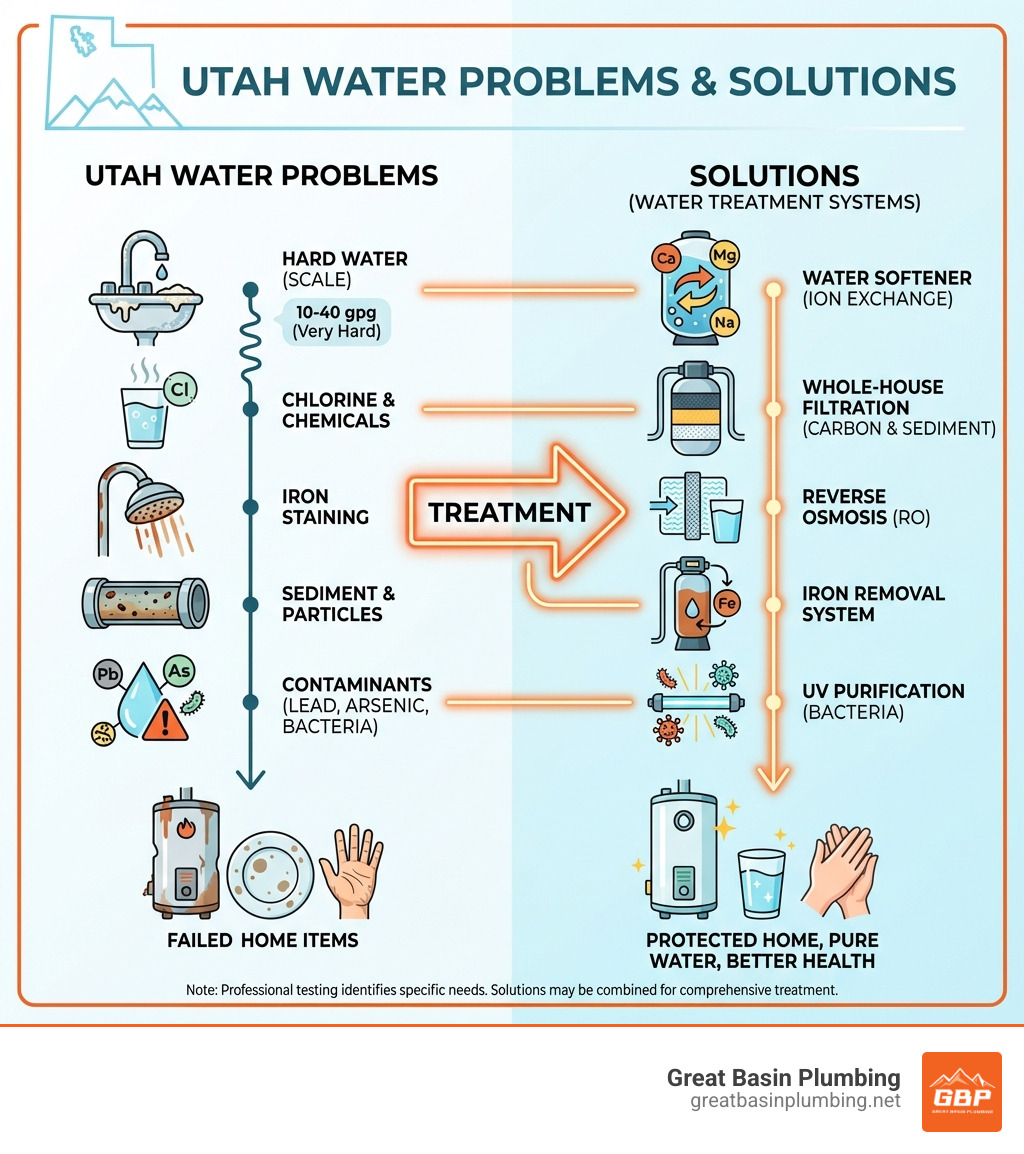
This infographic illustrates common Utah water quality issues including hard water scale buildup on fixtures (10-40 gpg hardness), chlorine taste and odor from municipal treatment, iron staining from well water, and sediment contamination, paired with their respective treatment solutions: water softeners for hardness, activated carbon filters for chlorine and taste, iron removal systems for staining, and sediment filters for particulate matter.
The Unseen Challenge: What’s Really in Your Utah Water?
When we turn on the tap in Salt Lake City or Park City, we expect clean water. However, Utah’s water quality presents unique challenges that impact our health and homes.
One of the biggest issues is extreme water hardness. Averaging 10-40 gpg, our water is classified as “Very Hard” by the Water Quality Association (anything over 10.5 gpg). This means high levels of dissolved calcium and magnesium, which, while not harmful to drink, cause mineral buildup in plumbing and appliances.
Beyond hardness, Utah’s water can contain other contaminants depending on the source:
- Arsenic: A carcinogenic element found in groundwater that can cause serious long-term health issues.
- Chlorine and Chloramine: Disinfectants used in municipal water that create an unpleasant taste and odor and can be corrosive to pipes.
- Heavy Metals: Lead, chromium, and copper can enter the water from industrial runoff or aging plumbing, posing serious health risks.
- Nitrates: Primarily from agricultural runoff, these are a concern for infants and pregnant women.
- Sediment: Particulates like silt and rust that affect water clarity, taste, and can clog appliances.
Understanding these issues is the first step toward finding effective water treatment systems Utah residents can trust.
Municipal vs. Well Water in Utah
Your water source—municipal or private well—determines your treatment needs.
Municipal Water: For homes in areas like Ogden or Draper, the main concerns are disinfectants like chlorine and chloramine, which affect taste and can be corrosive. Treatment focuses on removing these chemicals to improve water quality and protect plumbing.
Well Water: For residents with private wells, especially in rural areas like Box Elder County, the challenges are more complex. Untreated well water can contain bacteria (E. coli), iron, sulfur, and agricultural chemicals. Well-specific lab tests are critical to identify contaminants and choose an effective treatment system. For more details, explore our resources on A treatment system built for Utah well water.
For general emergency preparedness, the Red Cross website offers valuable basic water treatment information.
Telltale Signs of Poor Water Quality
Your water often signals when it needs help. Here are common signs that you may need a water treatment systems Utah solution:
- Stains on Fixtures and Sinks: Reddish-brown stains suggest iron, while white, chalky buildup (scale) indicates hard water.
- Dry, Itchy Skin and Dull Hair: Hard water minerals react with soap to form a film that clings to skin and hair, stripping away moisture.
- Spotty Dishes After Washing: Mineral deposits left behind by hard water cause cloudy spots on glasses and silverware.
- Reduced Appliance Efficiency and Lifespan: Scale buildup inside water heaters, dishwashers, and washing machines forces them to work harder, use more energy, and fail sooner.
- Unpleasant Taste or Odor: A “rotten egg” smell points to sulfur, a bleach taste suggests chlorine, and a metallic taste can indicate iron or other metals.
- Frequent Plumbing Issues: Mineral buildup can narrow pipes, reduce water pressure, and contribute to corrosion and leaks. For related concerns, see our guide on How to Find a Water Leak in the House.
Your Guide to Common Water Treatment Technologies
Now that we understand the challenges, let’s explore the technologies available to transform your water.
Why Water Softeners are Essential Water Treatment Systems in Utah
Given Utah’s notoriously hard water, water softeners are an essential part of many water treatment systems Utah homes need.
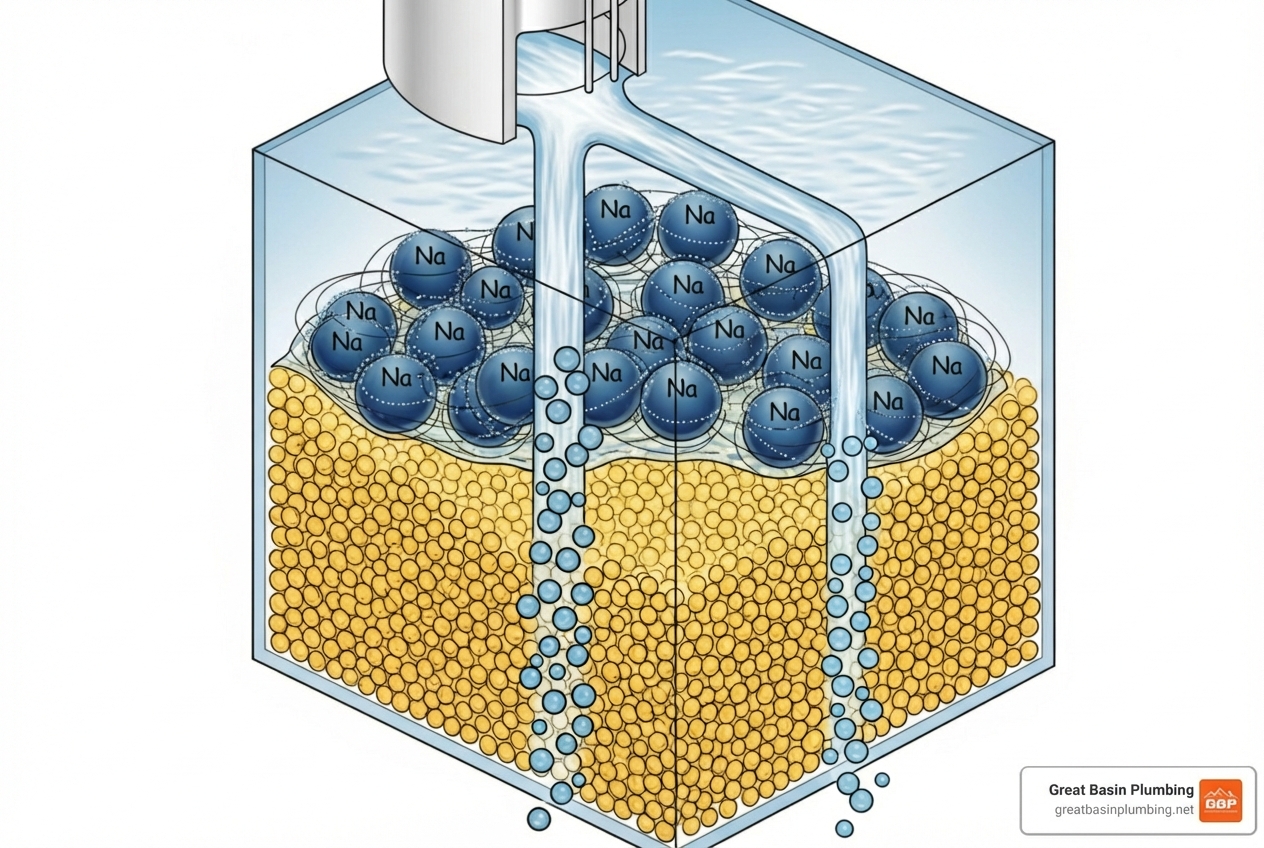
Water softeners use an ion exchange process. Hard water, containing calcium and magnesium ions, flows through a tank of resin beads coated with sodium ions. The hardness minerals stick to the resin, exchanging places with the sodium ions. This removes the minerals, leaving you with soft water. The system periodically regenerates by flushing the resin with a salt solution, washing the hardness minerals away.
The benefits for Utah homes are significant:
- Appliance Lifespan Extension: Softened water prevents scale buildup in water heaters, dishwashers, and washing machines, protecting your investments and extending their lifespan.
- Reduced Soap and Detergent Usage: Soft water lathers more effectively, so you’ll use up to 45% less soap, detergent, and other cleaning products.
- Softer Skin and Hair: Soft water rinses away soap completely, leaving skin and hair feeling cleaner, smoother, and more hydrated.
- Spot-Free Dishes and Brighter Laundry: By preventing mineral residue, soft water results in sparkling dishes and brighter, cleaner clothes.
The Role of Reverse Osmosis (RO) for Pure Drinking Water
For the purest drinking water, reverse osmosis (RO) is one of the most effective water treatment systems Utah residents can choose. An RO system uses a semi-permeable membrane with microscopic pores that allow water molecules to pass through while blocking larger contaminants.
Most RO systems use a multi-stage filtration process:
- Sediment Pre-filter: Removes larger particles like dirt and rust.
- Activated Carbon Pre-filter: Removes chlorine and chemicals that can damage the RO membrane.
- RO Membrane: Forces water through, leaving behind contaminants like lead, arsenic, and dissolved solids.
- Post-filter: A final carbon filter polishes the water for a fresh, clean taste.
RO systems are typically installed under the kitchen sink to provide purified water for drinking and cooking. They offer superior taste and remove a broad range of contaminants, providing peace of mind and eliminating the need for bottled water.
Understanding Filters, Purifiers, and Refiners
Let’s clarify the differences between common water treatment systems Utah homeowners encounter:
| System Type | Primary Function | Contaminants Removed (Examples) | Best Application |
|---|---|---|---|
| Water Softener | Remove hardness minerals | Calcium, Magnesium | Whole-house |
| Water Purifier | Remove broad range of contaminants for drinking | Lead, Arsenic, Chlorine, Cysts, Bacteria, Viruses, TDS | Point-of-use (RO, UV) |
| Water Refiner | Soften water AND filter out chemicals | Hardness minerals, Chlorine, Chloramine, Sediment, Odors | Whole-house |
Activated Carbon Filters: These filters use porous carbon to absorb impurities like chlorine, chloramine, and VOCs, dramatically improving the taste and odor of tap water.
UV Purification Systems: Ultraviolet (UV) systems use UV-C light to disinfect water. The light penetrates bacteria, viruses, and other microorganisms, disrupting their DNA and neutralizing them. This is a chemical-free method ideal for homes on private wells where microbiological contaminants are a concern.
Water Refiners: Some systems, often called “water refiners,” combine a water softener and a whole-house carbon filter into a single unit. They remove both hardness minerals and chemicals like chlorine, providing soft, clean water throughout the entire home.
Choosing the Best Water Treatment Systems Utah Has to Offer
Finding the right fit for your home means considering your specific water quality. Choosing from the many water treatment systems Utah has to offer can feel daunting, but we can simplify the process.
Whole-House vs. Point-of-Use: What’s Right for You?
First, decide if you need to treat all the water entering your home or just water at specific faucets.
Whole-House Systems:
Installed at your home’s main water line, these “point-of-entry” systems treat every drop of water.
- Comprehensive Protection: A whole-house system protects your entire plumbing infrastructure and all water-using appliances from hardness, chlorine, and sediment.
- Benefits for Appliances: Your water heater, washing machine, and dishwasher will run more efficiently and last longer, saving you from costly repairs.
Point-of-Use (POU) Systems:
These systems treat water at a single location, like the kitchen sink.
- Targeted Treatment: The most common POU system is a reverse osmosis (RO) unit that provides highly purified water for drinking and cooking.
- Cost-Effectiveness: If your main concern is drinking water quality, a POU system can be a budget-friendly choice.
Many Utah homeowners opt for a combination: a whole-house softener for general protection and a POU RO system for pure drinking water.
Key Factors for Selecting Your Water Treatment Systems in Utah
When helping clients in areas like Sandy or Heber choose water treatment systems Utah homeowners will love, we consider these key factors:
- Water Source (Municipal vs. Well): This is the most critical factor, as each source has different contaminant profiles.
- Professional Water Test Results: A professional water test is the foundation of any good recommendation. It tells us exactly what’s in your water, eliminating guesswork. We at Great Basin Plumbing prioritize this step to ensure we address your specific issues.
- Household Size and Water Usage: Your daily water consumption dictates the right size and capacity for your system.
- Budget: We work with you to find a solution that balances upfront cost with long-term savings.
- System Maintenance Requirements: We’ll discuss the maintenance needs of different systems (e.g., salt refills, filter changes) so you know what to expect.
Our team provides solutions, not just installations. For any plumbing needs, our Utah Plumbing Services are always available.
The Process: From Water Testing to Installation
Our process for installing water treatment systems Utah is straightforward and transparent.
- Professional Water Analysis: We start with a comprehensive water test to identify specific contaminants, hardness levels, and pH. This is the foundation for a proper recommendation.
- Consultation: We explain your water report in plain language, listen to your concerns, and discuss what you want to achieve.
- Custom System Recommendation: Based on your test results, needs, and budget, we recommend a customized solution, not a one-size-fits-all approach.
- Professional Installation: Our licensed plumbers install your system correctly and efficiently, ensuring years of trouble-free service with a clean and punctual installation experience.
The Long-Term Payoff: Benefits and Upkeep of Your System
Investing in quality water treatment systems Utah is a strategic decision that yields significant long-term benefits for your household and finances.
Economic and Household Advantages
The initial investment in a water treatment system quickly pays for itself through various savings.
- Extending Appliance Lifespan: Hard water causes scale buildup in appliances like water heaters and dishwashers, increasing energy use and leading to premature failure. Soft water eliminates this scale, allowing appliances to run efficiently and last much longer. Our Utah Water Heater Services team sees the difference softened water makes.
- Saving Money on Soaps and Detergents: Soft water lathers more effectively, so you use less soap, shampoo, and detergent. Homeowners often report reducing their soap usage by up to 45%.
- Reduced Plumbing Maintenance: Soft water minimizes mineral buildup in pipes, protecting your plumbing system from clogs, corrosion, and costly repairs.
Health and Lifestyle Benefits of Treated Water
The health and lifestyle improvements from installing water treatment systems Utah can be truly transformative.
- Healthier Skin and Hair: Treated water rinses cleanly, leaving your skin feeling softer and your hair shinier and more manageable.
- Better Tasting Water: Removing chlorine and other impurities drastically improves the taste and odor of your tap water, coffee, and food.
- Reduced Exposure to Contaminants: Filtration and purification reduce your exposure to potentially harmful contaminants like lead, arsenic, and chlorine, providing peace of mind.
- Spotless Dishes and Brighter Laundry: Treated water ensures your dishes sparkle and your clothes stay cleaner and brighter.
Signs Your System Needs Maintenance or Repair
Even the best water treatment systems Utah has installed need proper care. Watch for these signs that your system needs attention:
- Changes in Water Pressure or Taste: A sudden drop in pressure or the return of unpleasant tastes can indicate a clogged filter or system malfunction.
- Return of Hard Water Spots: If you start seeing chalky spots on fixtures and dishes, your water softener may need salt or service.
- Salty Taste from Your Tap (Softener Issue): An unusually salty taste can indicate a problem with your water softener’s regeneration cycle.
- Unusual Noises from the Unit: Grinding or clunking noises can point to mechanical problems that need professional attention.
- Leaks: Any visible leaks around your system should be addressed immediately to prevent water damage. Our Utah Plumbing Leak Detection services can help.
- Reduced Flow from RO Faucet: A slow flow from your RO faucet usually means the filters need to be replaced.
- Importance of Regular Maintenance: Following the manufacturer’s schedule for filter changes and salt refills is crucial. An annual professional check-up can prevent major problems and ensure your system runs efficiently for years.
Conclusion: Your Path to Pure Water in Utah
We’ve explored Utah’s unique water challenges, from extreme hardness (10-40 gpg) to contaminants in municipal and well water. We’ve also covered the powerful solutions available, including water softeners, reverse osmosis, and whole-house filtration—all effective water treatment systems Utah homeowners can rely on.
Taking control of your home’s water quality is a smart investment. You’ll experience economic benefits through longer appliance life and savings on soaps, and enjoy profound health and lifestyle improvements like softer skin, better-tasting water, and protection from contaminants.
Don’t let hard water stains, unpleasant tastes, or hidden contaminants diminish your home comfort. For a professional water analysis and expert advice on the right Utah Water Treatment Systems for your needs, contact the specialists at Great Basin Plumbing. We’re here to ensure your water is pure and simple.