
Why Drain Pipe Problems Won’t Wait (And How to Fix Them)
Drain pipe repair is the process of fixing cracked, leaking, or broken pipes that carry wastewater away from your home. Here’s what you need to know:
- For minor leaks: Use pipe clamps, epoxy putty, or rubber connectors as temporary fixes
- For major damage: Replace broken sections with new PVC or ABS pipe, or consider trenchless methods like CIPP lining
- Call a professional when: You see sewage backups, multiple clogged drains, or foundation cracks
- Cost range: DIY fixes run $10-50, professional repairs range from $150-$4,000+ depending on severity and method
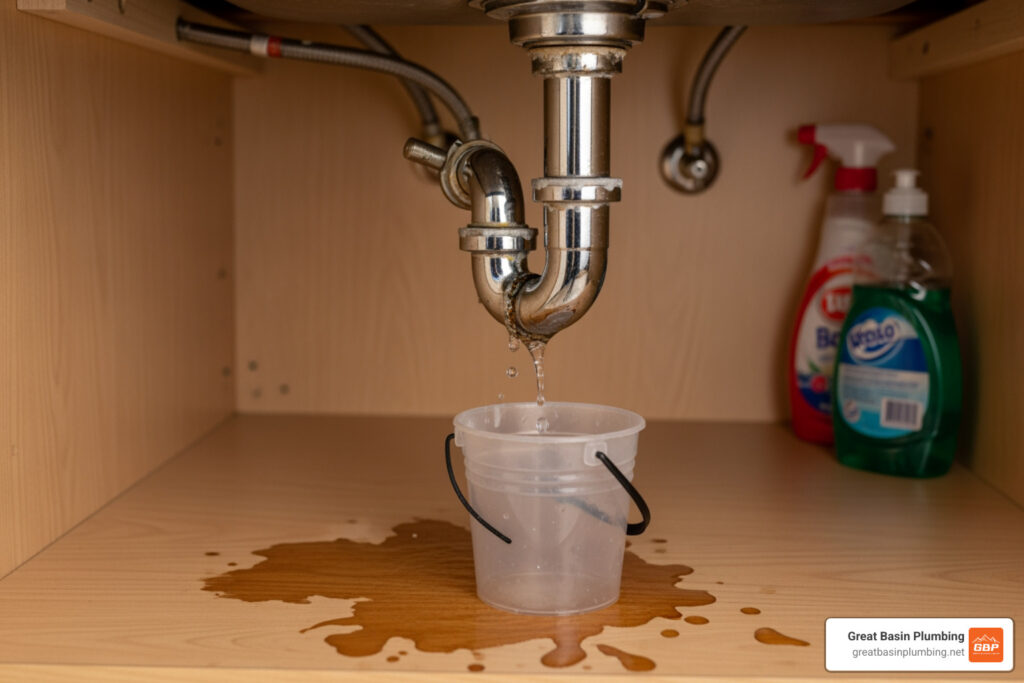
If you have a leaking drain pipe, it is almost imperative that you fix it immediately. A leak can start out small but quickly grow into a big problem. Leaking sewage can harbor disease, contain hazardous chemicals, and provide a thoroughfare for rats into your home. Water damage to floors, walls, and foundations can cost thousands to repair if left unchecked.
The good news? Many drain pipe issues can be fixed without major excavation or expense—if you catch them early and know what you’re dealing with.
The challenge is knowing when a quick DIY patch will hold and when you need a full pipe replacement. Understanding the different types of drain pipes in your home (PVC, ABS, cast iron), recognizing warning signs like slow drains or foul odors, and choosing the right repair method can save you both time and money.
I’m Reese Mitchell, owner of Great Basin Plumbing, and over the years I’ve seen how proper drain pipe repair techniques can prevent small problems from becoming expensive disasters. In this guide, I’ll walk you through diagnosing damage, making temporary fixes, and knowing when to call in the pros.
First, Diagnose the Damage: Signs, Causes, and Pipe Types
Before starting a drain pipe repair, you need to diagnose the problem. Understanding the clues your pipes are giving and what material they’re made of is crucial for an effective fix.
Common Causes of Drain Pipe Damage
Over time, various factors can lead to drain pipe damage. Here are the most common culprits:
- Aging Pipes: Especially in older Utah homes, materials like clay and cast iron (common before the mid-1970s) don’t last forever. Cast iron rusts and deteriorates, leading to breaks and clogs. The U.S. Environmental Protection Agency (EPA) notes that aging sewer infrastructure is a major problem nationwide, causing numerous sewer overflows.
- Tree Root Intrusion: Tree roots seek water and can enter tiny cracks in drain pipes. Once inside, they grow, expanding cracks, creating blockages, and eventually causing the pipe to collapse. This is a major cause of clogged sewer lines.
- Clogs and Blockages: Persistent or severe blockages from grease, foreign objects, or sludge can put immense pressure on pipes, leading to cracks or bursts.
- Ground Movement and Shifting Soil: Utah’s dynamic soil can shift due to freeze-thaw cycles, seismic activity, or natural settling. This movement stresses underground pipes, causing sagging sections, displaced joints, or breaks. Shifting foundations are often linked to broken pipes.
- Temperature Fluctuations: Extreme temperature changes cause pipes to expand and contract. While modern materials are resilient, older or weakened pipes can crack under this stress.
- Corrosion: Corrosion is a major issue for metal pipes like cast iron. It thins the pipe walls, leading to leaks or breaks. Leaking joints often result from corrosion and age as old sealants fail.
- Physical Impact or Accidental Damage: Damage can also be accidental. Construction, digging, or heavy vehicles driving over buried lines can cause pipes to crack or collapse.
Identifying Your Pipe Material
Knowing your drain pipe material is key to choosing the right drain pipe repair method, as materials have different lifespans and vulnerabilities.
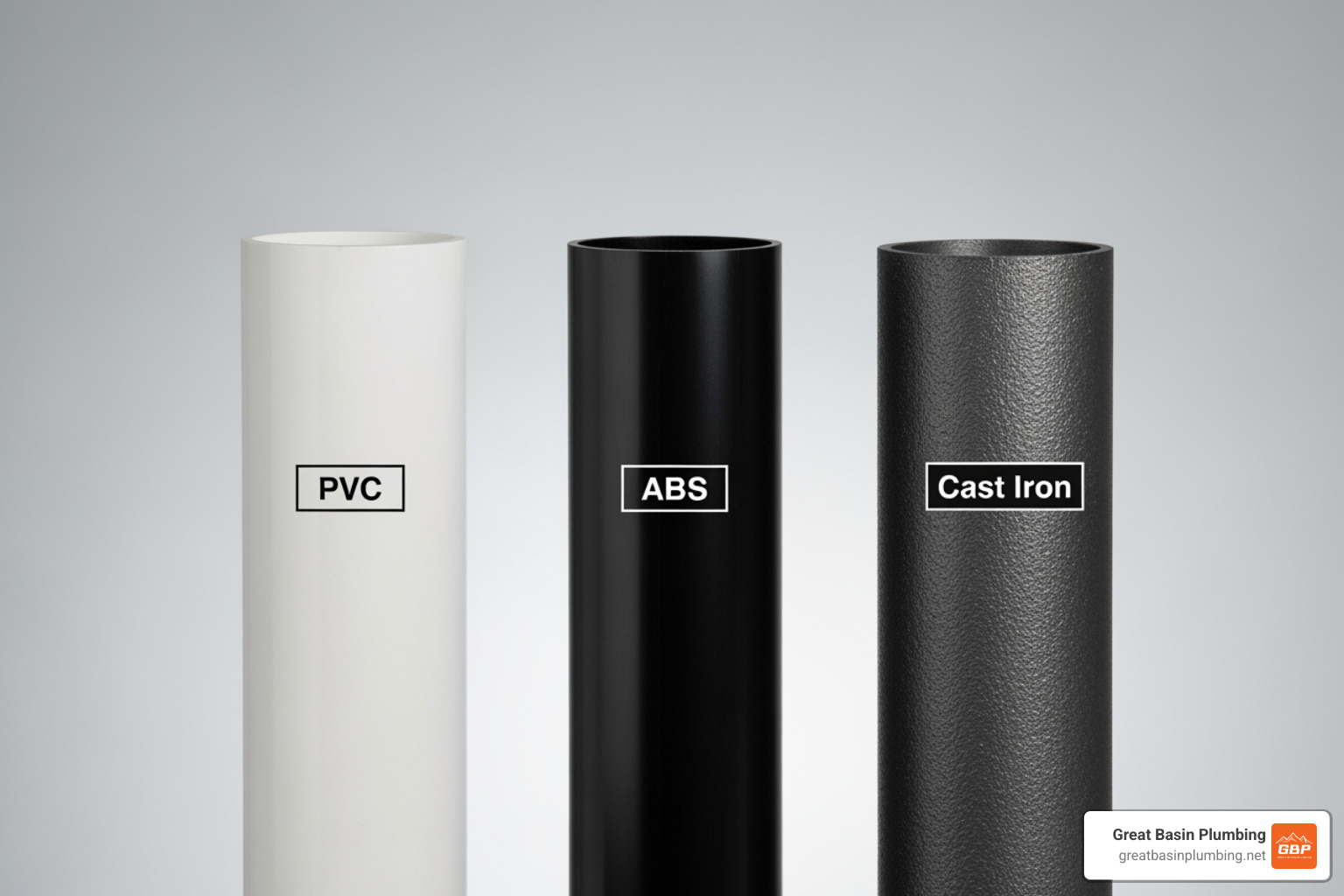
Here’s a breakdown of common pipe materials in Utah homes:
- Cast Iron Pipes:
- Characteristics: Heavy, dark gray metal common in pre-1970s homes.
- Vulnerabilities: Prone to rust, corrosion, and cracking over time.
- Repair Note: Widespread deterioration often requires replacement.
- PVC Pipes (Polyvinyl Chloride):
- Characteristics: White, rigid plastic used in drain, waste, and vent (DWV) systems since the mid-1970s.
- Vulnerabilities: Can become brittle in cold, be damaged by chemicals, or be crushed if not buried properly.
- Repair Note: Sections are easily repaired or replaced with solvent cement.
- ABS Pipes (Acrylonitrile Butadiene Styrene):
- Characteristics: Black, rigid plastic similar to PVC, common in DWV systems.
- Vulnerabilities: Can degrade with UV light exposure and certain chemicals.
- Repair Note: Like PVC, sections are easily replaced using specific ABS solvent cement.
- Clay Pipes:
- Characteristics: Brittle, orange-brown material in older sewer lines.
- Vulnerabilities: Highly susceptible to root intrusion and cracking from ground movement.
- Repair Note: Widespread issues often require full replacement or trenchless lining.
- Copper Pipes:
- Characteristics: Reddish-brown metal, sometimes used for smaller, older drain lines.
- Vulnerabilities: Can corrode over time, leading to pinhole leaks.
- Repair Note: Can be repaired, but extensive corrosion may require repiping.
- Galvanized Steel:
- Characteristics: Grayish metal sometimes used for older drain lines.
- Vulnerabilities: Prone to internal rust and mineral buildup, reducing flow and causing corrosion.
- Repair Note: Difficult to repair; often requires replacement.
We use video camera inspections to see inside your pipes, identifying the exact location and nature of the damage and the pipe material. This precise diagnosis is key to selecting the correct long-term solution and avoiding unnecessary excavation.
DIY Quick Fixes for Minor Leaks
Sometimes, a small leak just needs a quick, temporary solution to buy you time until a proper, permanent drain pipe repair can be done. Since drain pipes typically operate under low pressure (unlike pressurized water supply lines), many temporary fixes can be surprisingly effective. However, remember these are generally temporary solutions—they’re meant to stop the immediate leak, not to last for decades.
How to Apply a Temporary Patch for Drain Pipe Repair
For minor cracks or small leaks, especially on accessible pipes under a sink or in a utility area, we often suggest these DIY methods as a stop-gap measure. Always remember to prioritize safety: turn off the water supply to the affected area if possible, and wear gloves and eye protection.
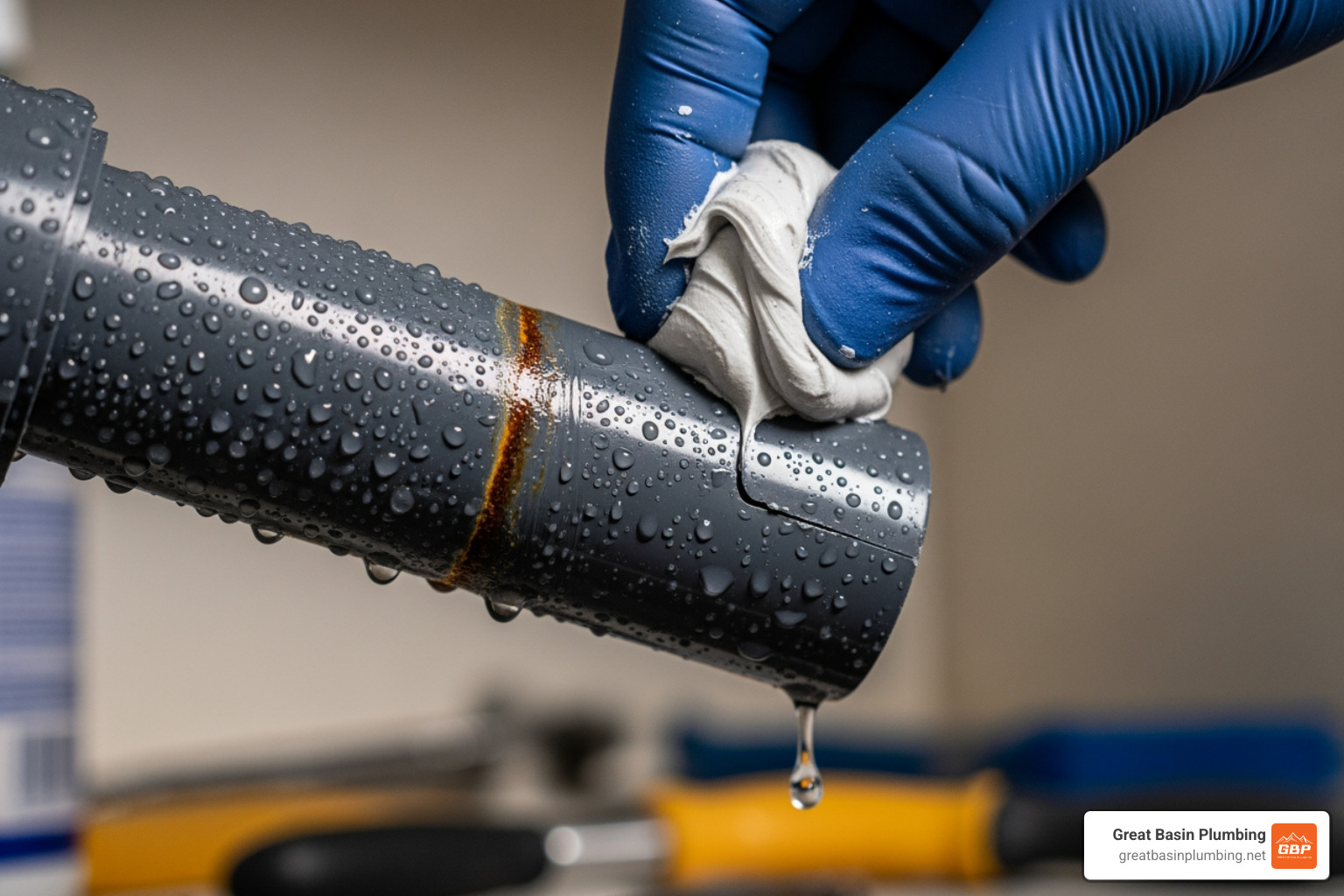
- Clean the Area: This is crucial for any successful patch. The pipe surface must be thoroughly clean, dry, and free of grease or debris. Use a clean cloth to wipe down the area. If it’s a slow leak, you might need a heat gun to ensure it’s completely dry.
- Sand the Surface: Lightly sand the area around the crack or leak with fine-grit sandpaper. This creates a rough surface that helps the repair material adhere better.
-
Apply Repair Material:
- Epoxy Putty: This is a fantastic option for small cracks or leaks, especially at couplings where it’s hard to wrap something tightly. You simply knead the two-part putty together until it’s a uniform color, then press it firmly into the leak and around the damaged area. It will harden to create a seal. We’ve used epoxy putty for these kinds of fixes.
- Pipe Repair Clamps/Repair Sleeves: These are readily available at hardware stores. They consist of a rubber gasket and a metal clamp. For a quick temporary fix, you can use a repair sleeve, or clamp. You position the rubber gasket over the leak and then tighten the clamp securely around the pipe. They’re great for accessible, straight pipe sections.
- Rubber Pipe Connectors: For long, straight sections where a pipe needed to be cut (perhaps to remove a damaged piece), rubber pipe connectors are very handy. You slip one side onto an existing pipe end, align the pipes, and then slide the connector over the break and tighten down the hose clamps.
- Fiberglass Wraps (Pipe Wraps that Harden): These wraps are impregnated with resin. You activate them by soaking them in water, then wrap them tightly around the leak. They harden into a solid, watertight shell. These can be very effective for small leaks on straight pipes or even around joints.
- Denso Tape: This is a heavy, petroleum-based tape that can be wrapped tightly around a pipe. It’s known for creating a strong, temporary seal. Just a heads-up: it can be messy to work with, so several pairs of disposable rubber gloves are highly recommended!
- Rubber Band (for very low-pressure drains): Believe it or not, for a simple crack in a cast iron kitchen drainage pipe, a rubber band wrapped tightly around it has been known to hold for over 20 years! Since drain pipes have no significant pressure, this can be a surprisingly effective temporary fix until a proper repair can be scheduled.
-
Allow to Cure: Each repair material will have specific curing times. It’s crucial to follow the manufacturer’s directions. For glues or epoxy, this can range from 12 to 24 hours. Don’t use the drain until the recommended time has passed to ensure a strong, watertight seal.
- Test for Leaks: Once the curing time is complete, slowly turn on the water supply and check for any leaks. Monitor the repaired section closely for a day or two to ensure the patch is holding.
While these DIY fixes can be lifesavers in a pinch, we always recommend reaching out to us for significant pipe problems. An expert can accurately diagnose the issue and recommend the best repair method to ensure your plumbing system operates reliably for years. For more quick fix ideas, you can also See this article.
A Guide to Major Drain Pipe Repair Methods
When damage is extensive, it’s time for robust drain pipe repair methods. Modern technology offers less disruptive solutions than the major excavation required in the past, saving you time, money, and stress.
Traditional vs. Trenchless Repair
The fundamental choice for major drain pipe repair often boils down to two categories: traditional (excavation) or trenchless.
Traditional Pipe Repair Methods
Traditional repair is a “dig-and-replace” approach. We dig a trench to expose and replace damaged pipe sections. While effective, it’s highly disruptive to your lawn, driveway, or foundation. This method is necessary for severely collapsed or deteriorated pipes.
Trenchless Pipe Repair Methods
Trenchless methods repair or replace pipes with minimal to no digging, using the existing pipe as a host for a new liner. This reduces disruption and is ideal for pipes under driveways, landscaping, or buildings. The demand for these innovative solutions is significant, reflecting their convenience and cost-effectiveness.
Here’s a comparison to help you understand the differences:
| Feature | Traditional (Excavation) Repair | Trenchless Repair Methods |
|---|---|---|
| Cost | Can be higher due to extensive labor and property restoration | Often comparable or lower, especially considering restoration costs |
| Time | Longer, due to excavation, repair, and restoration | Shorter, as digging is minimized or eliminated |
| Disruption | High (yard, landscaping, driveway, foundation impacted) | Minimal to none (small access points) |
| Longevity | New pipe can last 50+ years | New liner/pipe can last 50+ years |
| Best For | Severely collapsed pipes, significant bellies, full replacement | Cracks, leaks, root intrusion, joint failure, structural renewal |
Modern Trenchless Repair Options
Trenchless technology is a game-changer, restoring plumbing systems with minimal excavation and disruption. Here are the leading methods we use:
- Cured-in-Place Pipe (CIPP) Lining: One of the most popular methods, CIPP involves inserting a resin-saturated liner into the damaged pipe. It’s inflated and cured to create a new, seamless pipe within the old one, sealing cracks and preventing root intrusion. CIPP can extend a pipe’s life by 50+ years and is suitable for various pipelines. We use certified materials meeting industry standards (ANSI/NSF 14, ASTM, etc.) for the highest quality installations. For more details, see the EPA’s Collection Systems O&M Fact Sheet: Trenchless Sewer Rehabilitation.
- Pipe Bursting: This trenchless replacement method pulls a new pipe through the old one, fracturing the old pipe outward. A “bursting head” breaks the old pipe and pushes it into the surrounding soil. This allows for replacement with a same-size or larger-diameter pipe, improving flow. It’s ideal for replacing old, brittle pipes (clay, concrete, cast iron).
- Slip Lining: An older trenchless method, slip lining involves inserting a smaller carrier pipe (HDPE or PVC) into the damaged host pipe. The gap between them is often filled with grout for stability. While it slightly reduces the pipe’s internal diameter, it provides a durable repair.
- Pipe Coating: This trenchless service applies a tough new coating to the inside of a sewer pipe, often after descaling. It prevents erosion, corrosion, and leaks, improving water quality. An epoxy coating can extend a metal pipe’s life by 30-50 years.
We are proud to offer advanced trenchless solutions across Utah, including Sandy, Ogden, Orem, and Draper. For more information on our comprehensive sewer services, please visit our More info about sewer services page. We also provide More info about piping and repiping services for all your pipe replacement needs.
When to Call a Professional (And How to Prevent Future Issues)
While DIY is great, some situations require a professional plumber. Ignoring these signs can lead to bigger, more expensive problems.
When to call us for drain pipe repair:
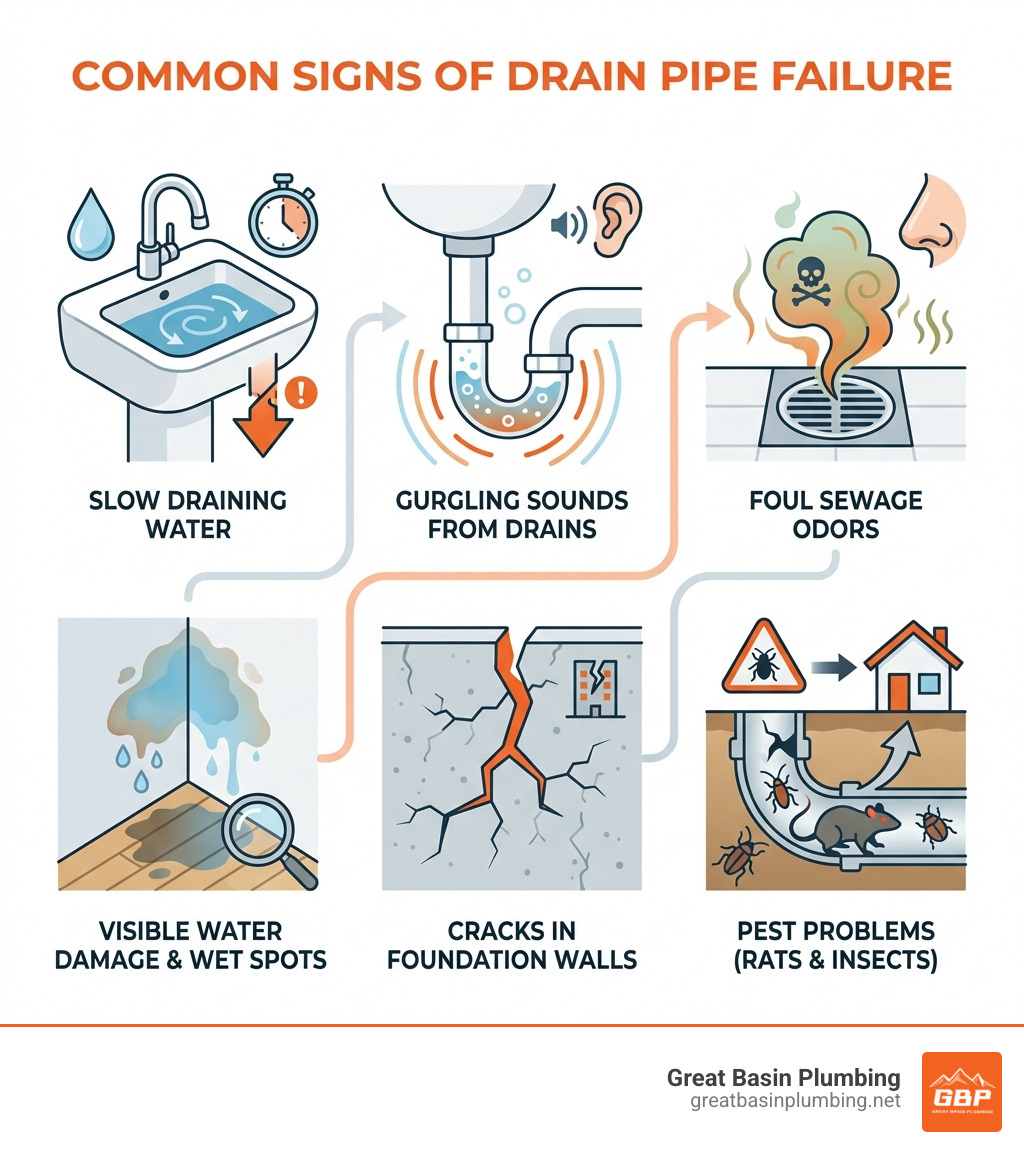
- Multiple Clogged Drains or Frequent Backups: If you’re constantly dealing with slow drains, gurgling sounds from multiple fixtures (sinks, tubs, toilets), or frequent toilet clogs, it’s a strong indicator of a main sewer line issue, not just a localized clog. This is beyond a plunger’s capabilities.
- Sewage Backups: Any presence of raw sewage or water backing up into basement drains or first-floor tubs/showers is an emergency. This poses significant health risks and requires immediate professional attention.
- Major Leaks or Visible Water Damage: If you find a significant leak, visible water damage on walls or ceilings, or unexplained wet spots in your yard, it’s time for us to step in. A leak can quickly grow into a big problem, causing structural damage.
- Foul Odors: A persistent sewer smell coming from your drains or yard can indicate a break in your sewer line, allowing sewer gases to escape. This isn’t just unpleasant; it can be a health hazard.
- Rats or Pest Problems: Believe it or not, rats or rat holes in your yard or parking strip can be a sign of a broken sewer line. They use these breaches as thoroughfares.
- Foundation Cracks: Visible cracks in your home’s foundation can sometimes be linked to leaking drain pipes, which can cause soil erosion and settlement.
- Older Pipe Materials: If your home has older cast iron, clay, or concrete pipes, especially if you’re experiencing recurring issues, it’s wise to have us perform a video camera inspection. These materials are past their prime and often require professional diagnosis and repair.
- Any Uncertainty: If you’re unsure about the extent of the damage, the type of pipe, or the best repair method, it’s always best to consult a professional. What seems like a small issue could be a symptom of a larger, underlying problem.
We offer experienced, 24/7 emergency plumbing, drain cleaning, and water heater services throughout Utah, including Sandy, Brigham City, and Box Elder County. For any drain issue, big or small, don’t hesitate to reach out. For more information on our expert drain services, visit our More info about drain services page.
The Cost of Drain Pipe Repair
The cost of drain pipe repair varies dramatically based on the job’s complexity.
- DIY Fixes: As we discussed, temporary DIY patches typically cost $10-$50 for materials like epoxy putty, clamps, or tape. These are the most budget-friendly options, but remember, they are usually not permanent solutions.
- Professional Repair Methods:
- Minor Repairs (e.g., small leak, simple clog removal): These can range from $150 to $500, depending on accessibility and the time involved.
- Traditional Excavation and Replacement: This can be one of the more expensive options, ranging from $1,000 to $4,000 or more per section, and potentially $5,000 to $20,000+ for a full sewer line replacement. Costs are driven by labor for digging, pipe materials, and the extensive restoration needed for your landscaping, driveway, or foundation.
- Trenchless Repair (CIPP, Pipe Bursting, Slip Lining): While the initial cost per foot can sometimes be higher than traditional digging for short sections, the overall project cost can often be comparable or even lower because it drastically reduces the need for expensive excavation and property restoration. These methods typically range from $3,000 to $15,000+, depending on the length, diameter, and complexity of the repair.
- Factors Influencing Cost:
- Labor Costs: The plumber’s time and expertise.
- Material Costs: The type and amount of material needed.
- Repair Method: Trenchless methods can have different cost structures than traditional excavation.
- Pipe Location: A pipe under a concrete slab is more expensive to repair than an accessible one in a basement.
- Permit Fees: Major repairs often require local permits, which vary by city (like Ogden or Draper) and add to the cost.
- Inspection Costs: City inspections may add to the cost.
- Emergency Service: Emergency calls typically have higher rates.
We always provide honest, upfront pricing, so you’ll know the costs before we start any work.
How to Prevent Drain Pipe Damage
Proactive steps can save you from costly and messy drain pipe repair down the road.
- Mind What You Flush and Pour:
- Kitchen Drains: Never pour grease, oil, or fat down the drain. Let it cool and solidify, then scrape it into the trash. Avoid putting coffee grounds, eggshells, or fibrous foods down the garbage disposal.
- Bathroom Drains: Only flush human waste and toilet paper. Avoid flushing “flushable” wipes (they’re not truly flushable!), feminine hygiene products, cotton balls, or excessive hair.
- Regular Drain Cleaning: Regular drain cleaning prevents clogs. For issues like root growth or grease, we recommend annual main line cleaning. Our hydro jetting services can thoroughly clean pipes.
- Avoid Harsh Chemical Drain Cleaners: Avoid harsh chemical drain cleaners. They are corrosive, can damage pipes (especially older ones), and often fail to fully clear blockages.
- Gutter and Downspout Maintenance: Proper gutter drainage is crucial. Keep gutters clean and ensure downspouts divert water away from the foundation. Clogged underground drainage can burst pipes, so ensure your system functions correctly to protect your foundation.
- Install Drain Screens/Hair Catchers: Simple screens in your sinks and showers can catch hair, soap scum, and food particles before they enter your pipes.
- Be Mindful of Tree Roots: If you have large trees near your sewer lines, consider having a video camera inspection done every few years to check for root intrusion. Sometimes, root removal treatments can be applied before roots cause significant damage.
- Annual Plumbing Inspections: We recommend annual plumbing inspections, especially for older homes. An inspection can identify issues early, allowing for proactive drain pipe repair before they become emergencies. This is valuable in areas like Provo and Salt Lake City where home ages vary.
Your Next Steps for a Healthy Plumbing System
We’ve covered a lot about drain pipe repair, from diagnosing the subtle signs of trouble to understanding the various repair methods, both DIY and professional. The key takeaway is this: timely action and informed decisions are your best friends when it comes to maintaining a healthy plumbing system.
Whether it’s a quick patch with epoxy putty for a minor leak or a comprehensive trenchless repair for a major sewer line issue, addressing drain pipe problems promptly can save you from messy, costly, and inconvenient disasters. While temporary fixes can buy you time, they are rarely permanent solutions.
If you’re noticing persistent slow drains, foul odors, unusual water spots, or any other signs that your drain pipes are struggling, don’t hesitate. A professional diagnosis, often using advanced video camera inspections, can pinpoint the exact problem and help you choose the most effective, long-term solution. Our team at Great Basin Plumbing is ready to help homeowners and businesses across Utah, including Ogden, Pleasant View, and Heber. We pride ourselves on transparent communication and quality workmanship.
For any plumbing needs, from routine maintenance to emergency drain pipe repair, we’re here for you. Learn more about our comprehensive plumbing services and how we can keep your home running smoothly by visiting our website: More info about our plumbing services.