
The Unsung Hero of Your Home Comfort
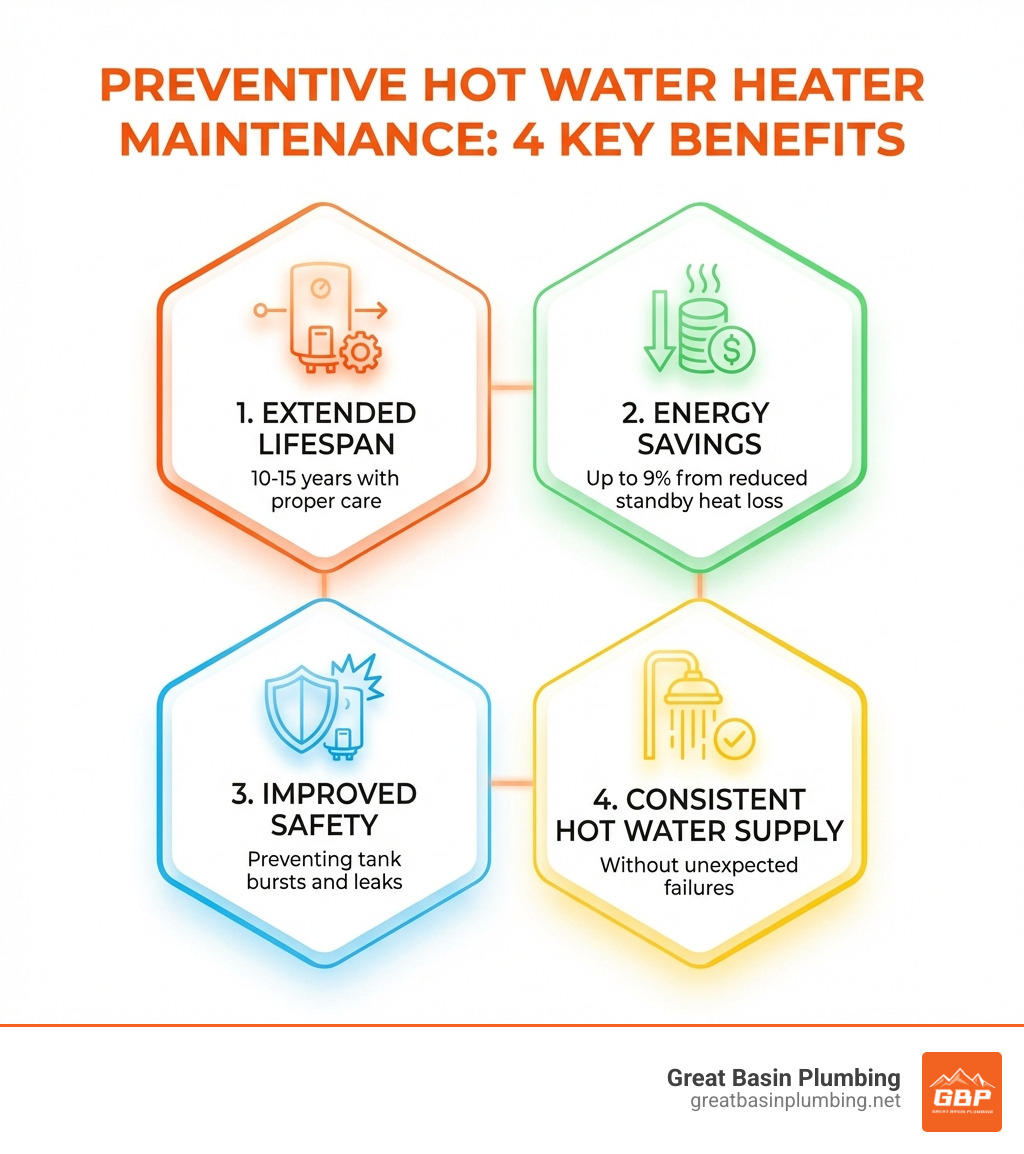
Preventive maintenance on a hot water heater is your best defense against cold showers and costly repairs. Performing simple annual tasks—flushing the tank, testing the TPR valve, inspecting the anode rod, and adjusting the temperature—extends your water heater’s lifespan, improves efficiency, and prevents breakdowns.
Essential preventive maintenance tasks include:
- Flushing the tank annually (every 6 months for hard water) to remove sediment.
- Testing the Temperature and Pressure Relief (TPR) valve to ensure it functions correctly.
- Inspecting and replacing the anode rod every 3-5 years to prevent tank corrosion.
- Adjusting the temperature to 120°F for safety and efficiency.
- Checking for leaks around all connections.
Most water heaters work constantly but are easy to forget—until something goes wrong. Sediment buildup reduces efficiency, a worn-out anode rod invites rust, and a faulty TPR valve can be dangerous. These issues often appear suddenly as a flooded utility room or a cold shower.
The good news? Regular attention prevents most of these problems, keeping your heater efficient, lowering energy bills, and ensuring consistent hot water. For Sandy, UT homeowners dealing with mineral-rich water, this maintenance is even more critical.
I’m Reese Mitchell, owner of Great Basin Plumbing. I’ve seen how preventive maintenance saves homeowners thousands in emergency repairs and premature replacements. My team helps families and businesses across Utah keep their plumbing and water heaters running smoothly.
Why Regular Maintenance is a Non-Negotiable Task
Just like your car needs regular service, your water heater requires attention to prevent minor issues from becoming major expenses. Neglecting it can lead to a cascade of problems.
Signs of neglect are often subtle at first. You might notice rusty water from faucets (indicating tank corrosion) or popping noises, a clear sign of sediment buildup. This sediment from hard Utah water settles in the tank, forming a barrier over the heating element. This reduces efficiency, forces the unit to work harder, and can damage the tank.
The consequences of this neglect are real:
- Reduced efficiency and higher bills: Sediment forces your heater to use more energy. Setting the temperature too high can also waste over $60 annually in standby heat loss, according to the U.S. Department of Energy.
- Risk of leaks and water damage: A neglected anode rod leads to corrosion and leaks, causing significant damage.
- Premature breakdown: Proper care extends a tank heater’s life to 10-12 years (tankless up to 20). Neglect shortens this lifespan, leading to expensive replacement.
Proactive care extends your heater’s lifespan, saves money on energy and repairs, and prevents breakdowns, keeping your home running smoothly. For more insights on keeping your water heater healthy, especially during colder months, check out our guide on common winter issues.
Key Components That Need Your Attention
To understand preventive maintenance on a hot water heater, you need to know its vital parts:
- Anode rod: The “sacrificial rod” that attracts corrosive elements to protect the tank. Inspect and replace every 3-5 years.
- Temperature and Pressure (TPR) valve: A critical safety device that relieves excessive pressure (over 150 psi) or temperature (over 210°F) to prevent tank rupture.
- Drain valve: Located at the bottom of the tank for draining water and flushing sediment.
- Heating element (electric) / Burner assembly (gas): Heats the water. Sediment can coat these parts, reducing efficiency.
- Dip tube: Directs incoming cold water to the bottom of the tank for heating, preventing it from mixing with hot water at the top.
- Thermostat: Sets the water temperature. Proper adjustment is key for safety and efficiency.
The Payoff: Benefits Beyond Preventing Breakdowns
The benefits of regular preventive maintenance on a hot water heater go beyond avoiding breakdowns to optimizing your home’s efficiency and comfort.
- Improved energy efficiency: Flushing sediment allows your unit to heat water more efficiently. Insulating an older tank can reduce standby heat loss by 25-45%, saving up to 9% on water heating costs.
- Lower utility costs: An efficient water heater uses less energy, saving you money. Lowering the temperature 10 degrees can save up to 5% in energy costs.
- Better water quality: Flushing removes mineral deposits, improving your water’s taste and smell.
- Quieter operation: Flushing eliminates the rumbling or popping noises caused by sediment buildup.
- Peace of mind: A well-maintained heater is one less thing to worry about.
- Increased home safety: A working TPR valve prevents pressure buildup, while a maintained gas unit ensures proper ventilation to avoid carbon monoxide risks.
Getting Started: Safety First and Tools You’ll Need
Before you begin any preventive maintenance on a hot water heater, safety is paramount. You’re dealing with electricity, gas, and hot water, so caution is essential.

Safety precautions:
- Turn off the power: For an electric heater, turn off its circuit breaker. For a gas heater, turn the gas valve to “Pilot” or “Off.”
- Shut off the cold water supply: Turn off the cold water inlet valve at the top of the heater.
- Let water cool: Wait a few hours for the water in the tank to cool to prevent scalding.
- Wear protective gear: Always wear work gloves and safety goggles.
- Ensure proper ventilation (for gas heaters): Make sure the area is well-ventilated.
Tools and Materials You’ll Need:
For basic preventive maintenance on a hot water heater, gather these items:
- Garden hose
- Large bucket
- Adjustable or pipe wrench
- Screwdriver
- Channel-lock pliers
- Teflon tape
- Replacement anode rod (if needed, typically $22-$50)
- 1 1/16″ socket and impact wrench (often needed for anode rod removal)
Your Annual Preventive Maintenance on a Hot Water Heater Checklist
Perform maintenance annually, or every six months in Utah’s hard water areas (like Sandy, Ogden, and Salt Lake City). Hard water accelerates sediment buildup. Even with a water softener, check the anode rod annually, as softened water can speed up its corrosion.
Step 1: Test the Temperature and Pressure (TPR) Valve
The TPR valve is a critical safety feature that prevents dangerous pressure buildup. Test it annually to ensure it works.
How to test the TPR valve:
- Place a bucket under the discharge pipe.
- Lift the valve’s lever for a few seconds. A rush of hot water should discharge into the bucket.
- Release the lever. The water flow should stop completely.
Signs of a faulty valve:
- If no water comes out, the valve is clogged and needs replacement.
- If water keeps dripping after you release the lever, the valve isn’t sealing and must be replaced.
A dripping valve might also signal high water pressure, possibly requiring a thermal expansion tank. If unsure, call a professional. For more details, we refer customers to reliable resources like this guide.
Step 2: Flush the Tank to Remove Sediment
Flushing sediment is a crucial step in preventive maintenance on a hot water heater, especially in Utah’s hard water areas. Sediment reduces efficiency, damages the tank, and causes rumbling noises.
Why flushing is important:
- Sediment effects: Sediment insulates the heating element, forcing the unit to work harder and raising energy bills. It can also cause overheating that damages the tank lining.
- Improved lifespan: Removing sediment protects the tank from damage, extending its lifespan.
Step-by-step flushing process:
- Prepare: Turn off power/gas and the cold water supply. Let water cool.
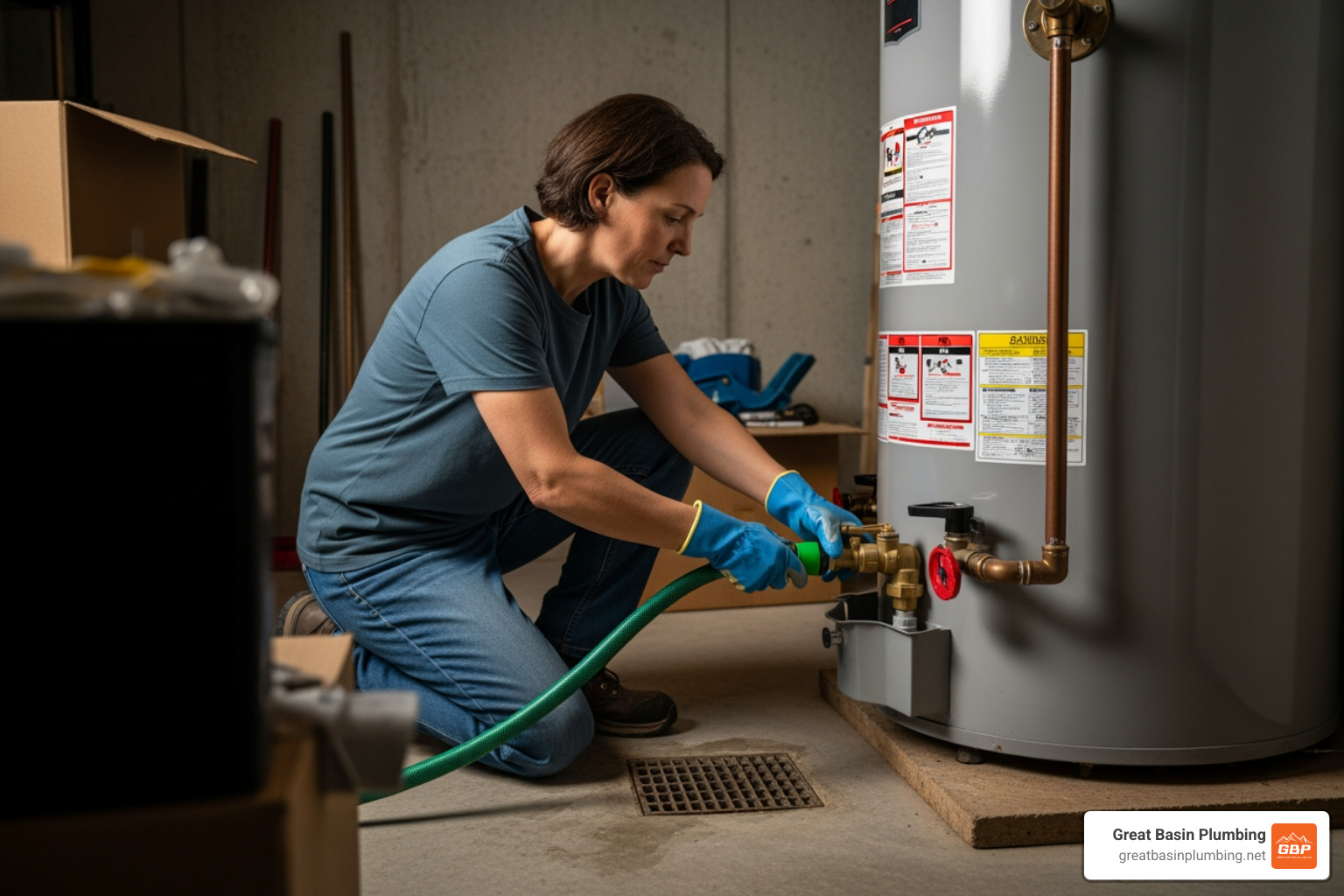
- Connect hose: Attach a garden hose to the bottom drain valve and run it to a safe drainage area.
- Open hot water faucet: Open a hot water faucet in the house to prevent a vacuum.
- Open drain valve: Open the heater’s drain valve to let water flow out.
- Stir sediment (optional): To help clear heavy sediment, briefly open and close the cold water supply valve a few times to stir up the tank bottom.
- Flush until clear: Let water drain until it runs clear.
- Close drain valve: Close the drain valve tightly.
- Refill tank: Close the drain valve and the hot water faucet. Slowly open the cold water supply to refill the tank. Once full, open a hot water faucet to purge all air from the system before restoring power.
- Restore power/gas: With the tank full and air purged, restore power or gas.
Step 3: Inspect and Replace the Sacrificial Anode Rod
The anode rod is a critical component that sacrifices itself to prevent tank corrosion. It’s a key part of preventive maintenance on a hot water heater.
Purpose of the anode rod:
The anode rod (magnesium, aluminum, or zinc) is more reactive than the steel tank. It attracts corrosive elements in the water, corroding itself instead of the tank.
How to inspect:
- Prepare: Turn off water and power/gas. Drain a few gallons to relieve pressure.
- Locate and loosen: Find the rod on top of the heater. You’ll need a 1 1/16″ socket and possibly an impact wrench to loosen it.
- Inspect: Unscrew and pull out the rod. Replace it if you see these signs:
- Signs of depletion: The rod is less than 1/2 inch thick, or its steel core wire is exposed.
- Calcium coating: It’s heavily coated with calcium.
Replacement process:
Replacing the rod is much cheaper than a new heater. Thread the new rod in using Teflon tape, tighten securely, and refill the tank. Check the rod every three years, or annually with a water softener in areas like Orem or Draper.
Fine-Tuning for Maximum Efficiency and Lifespan
After covering the basics of preventive maintenance on a hot water heater, let’s fine-tune your unit for maximum efficiency and longevity.
Adjusting Temperature and Managing Water Pressure
Temperature and pressure significantly impact your heater’s performance and safety.
Recommended temperature setting:
The ideal temperature is 120°F (49°C).
- Safety: Temperatures above 120°F increase the risk of scalding. Water at 140°F can cause third-degree burns in 5 seconds.
- Efficiency: Lowering your thermostat can save $36 to $61 annually in standby heat losses, according to the U.S. Department of Energy.
How to adjust:
- Gas heaters: Turn the thermostat dial on the front of the unit.
- Electric heaters: Turn off power at the breaker, remove the access panel, and adjust the thermostat(s).
Water pressure effects:
High water pressure stresses your plumbing and can lead to leaks. Ideal water pressure is 50-60 psi; plumbing codes cap it at 80 psi.
- Checking pressure: Use a pressure gauge on an outdoor spigot.
- Pressure Reducing Valve (PRV): If your pressure exceeds 80 psi, a PRV is recommended. It regulates incoming pressure to a safe level.
- Thermal expansion: In closed systems, common in Utah, heating water increases pressure. A dripping TPR valve is a common sign. An expansion tank, often required by code, absorbs this pressure. It must be pressurized to match your home’s water pressure.
Tank vs. Tankless: Key Maintenance Differences
While the goal is the same, maintenance methods differ for tank and tankless water heaters.
| Maintenance Task | Tank-Style Water Heater | Tankless Water Heater |
|---|---|---|
| Flushing/Descaling | Annually (every 6 months for hard water) to remove sediment | Annually to descale with vinegar/cleaning solution |
| Anode Rod Inspection | Every 3-5 years (annually with water softener) | Not applicable (no tank) |
| TPR Valve Testing | Annually | Annually (for models with a relief valve) |
| Inlet Filter Cleaning | Not applicable | Annually (or as needed) |
| Air Filter Cleaning | Not applicable (for gas tankless units) | Annually (or as needed) |
| Ventilation Check | Annually (especially for gas units) | Annually (critical for gas tankless units) |
Tankless heaters need yearly attention. Descaling with a vinegar solution is crucial to remove mineral buildup from the heat exchanger. Cleaning the air and inlet filters is also important for performance.
Insulating Your Tank and Pipes
Insulating your water heater and pipes is a simple, effective way to improve energy efficiency and lower bills.
How insulation works:
- Reducing standby heat loss: An insulation blanket reduces heat that escapes through the tank walls. The DOE estimates it can reduce standby heat loss by 25-45%, saving up to 9% on water heating costs.
- Pipe insulation: Insulating the first few feet of hot water pipes minimizes heat loss so water arrives faster. Insulating cold water pipes prevents condensation in summer.
Installation:
- Tank insulation blanket: Cut the blanket to fit, avoiding controls, thermostats, or the TPR valve. Secure with foil tape.
- Pipe insulation: Use pre-slit foam tubes that fit snugly around your pipes.
This simple upgrade can make a noticeable difference. For more tips, read our winterization checklist.
Frequently Asked Questions about Water Heater Maintenance
We often hear similar questions from our customers across Utah. Let’s tackle some of the most common ones.
How often should a water heater be flushed?
We recommend flushing your water heater annually. In areas with hard water, common in Utah, flush every six months. Flushing removes efficiency-robbing sediment, preventing damage and extending the unit’s life. This is a critical part of preventive maintenance on a hot water heater.
What are the signs my water heater needs to be replaced, not just maintained?
While preventive maintenance on a hot water heater helps, sometimes replacement is more cost-effective. Here are the signs it’s time for a new unit:
- Age: If your tank heater is over 10-15 years old and has issues, replacement is wise. Tankless units can last up to 20 years.
- Rust: Visible rust on the tank or rusty water (even after flushing) indicates severe internal corrosion and impending failure.
- Costly repairs: If repairs cost more than half the price of a new unit, it’s time for a replacement.
- Not enough hot water: If the unit can’t meet your needs despite maintenance, its heating elements or overall capacity may be failing.
If you’re in Utah, our article on water heater replacement costs can provide valuable insights.
Can I perform preventive maintenance on a hot water heater myself?
Yes, many basic tasks like flushing the tank, testing the TPR valve, and adjusting the temperature are DIY-friendly. However, for safety, leave tasks involving gas lines, electrical work, or replacing key components (like a seized anode rod) to licensed professionals. If you’re ever unsure, it’s safer and more efficient to call an expert.
When to Call the Pros: Your Utah Water Heater Experts
While basic DIY preventive maintenance on a hot water heater is encouraged, some situations require a professional. Knowing when to call an expert saves you time, money, and stress.
DIY limitations and signs you need a professional:
- Major leaks: A large puddle or steady stream of water requires immediate professional help.
- No hot water: If basic checks (power, gas, thermostat) don’t work, a major component may have failed.
- Gas smell: If you smell gas, evacuate immediately and call your gas company and a licensed plumber. This is a critical safety hazard.
- Complex repairs: Persistent noises, a dripping TPR valve, or burner/element issues require professional tools and expertise.
- Anode rod replacement: If the rod is stuck or you’re worried about damaging the tank, call a pro.
- Annual professional inspection: Even with DIY maintenance, a yearly pro inspection provides peace of mind. We can spot subtle issues and ensure peak performance and safety.
Great Basin Plumbing is your local, family-owned contractor serving Sandy, Brigham City, Ogden, American Fork, Salt Lake City, and more. Our team offers 24/7 emergency plumbing, drain cleaning, and water heater services with honest, upfront pricing. Your satisfaction is our priority.
Don’t get left in the cold. For expert service and peace of mind, contact our team for comprehensive Utah Water Heater Services. We’ll keep your water heater running safely and efficiently.